
African start-ups just raised 70% more. Why it’s still not enough
African tech start-ups raised about $583 million in the third quarter of 2026, the strongest quarter of the year so far, according to figures reported by Dabafinance. Other trackers count deals differently. Figures from TechCabal, published by Africa.com, put third-quarter funding at about $1.025 billion across 167 deals.
That is around 70 percent more than the $342 million raised in the same quarter of 2025, and a sign that investors are slowly returning after a long “funding winter”.
The numbers
- First quarter 2026: $382 million across 40 start-ups
- Second quarter 2026: $260 million across 38 start-ups
- Third quarter 2026: $583 million across 58 start-ups
Year-to-date totals in the same report put funding at about $1.39 billion across 137 start-ups, although the quarterly figures add up to a lower total, so the final numbers may be revised. On current trends, full-year funding could reach about $1.85 billion.
The long view
To understand where African tech stands, it helps to look back:
- 2022: $3.33 billion, the peak of the boom
- 2023: $2.4 billion
- 2024: $1.12 billion, the depth of the downturn
- 2025: $1.64 billion
- 2026: on track for about $1.85 billion
In other words, funding is recovering, but it remains well below the levels of 2022, when low global interest rates sent investors hunting for growth everywhere.
What changed
The funding boom of 2021 and 2022 was driven by cheap money. When interest rates rose around the world, investors pulled back from risky early-stage companies, and Africa was hit harder than most. Several high-profile start-ups shut down or cut staff.
The recovery has been more cautious. Investors now prefer companies with real revenue and a clear path to profit over those chasing growth at any cost. Debt financing, rather than selling shares, has become more common for more mature companies.
Where the money goes
Fintech, including payments, lending and digital banking, has long been the biggest destination for African start-up funding, and it remains a major draw. Investors are also backing companies in energy, logistics, health and, increasingly, artificial intelligence.
Funding is heavily concentrated. Nigeria, Kenya, Egypt and South Africa, often called the “Big Four”, have historically received the large majority of venture capital on the continent. Founders elsewhere still struggle to raise money.
What founders say they need
- Local capital. African pension funds and banks invest very little in start-ups, leaving founders dependent on foreign investors.
- Stable currencies. Sharp devaluations, as in Nigeria and Egypt, have hurt start-ups that earn in local currency but raised money in dollars.
- Clear regulation, especially for fintech and data.
What to watch
- Whether the fourth quarter continues the recovery.
- Large deals and exits, including acquisitions and stock market listings, which give investors confidence to return.
- Growth in AI-focused start-ups, as investment in African computing infrastructure rises.
October was weaker
The first figures since the third quarter point the other way. African start-ups raised $183 million in October, according to the tracker Africa: The Big Deal, as reported by Nairametrics. That is 58 percent less than in October 2025 and 24 percent below September. Over the first ten months of the year, start-ups raised $2.4 billion, 12 percent less than in the same period of 2025. The biggest October deals went to Morocco and Tanzania, at $40 million each.
Sources: Dabafinance, 5 October 2026; Africa.com, 16 October 2026; Nairametrics, 6 November 2026.
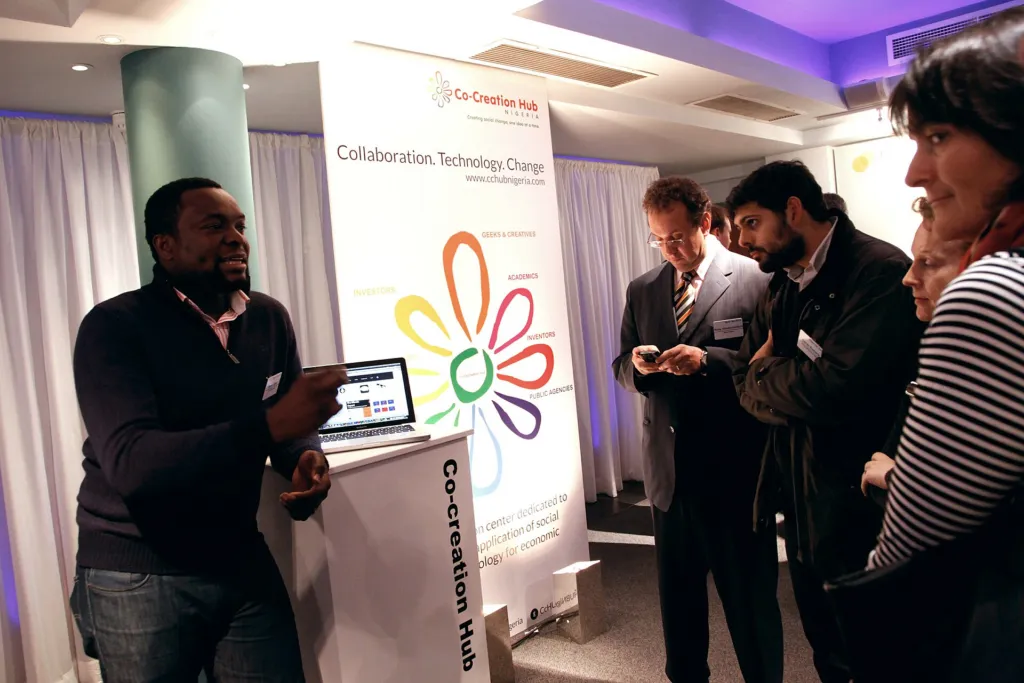
Top photo: Bosun Tijani, co-founder of the Co-Creation Hub in Lagos, presenting its work in 2012 (file photo). Photo: UK Department for International Development, Wikimedia Commons, CC BY 2.0
