
Half-built in a war zone: Mozambique’s $20 billion gas project ten months on
TotalEnergies restarted Mozambique LNG on 29 January 2026, after almost five years on hold. Ten months later, the $20 billion gas project in Cabo Delgado province is close to half built, but the Islamist insurgency that stopped it in 2021 has not gone away.
Where the project stands
- About 45 percent complete. TotalEnergies chief executive Patrick Pouyanné said in August that the project was “almost at 45% of completion”, with the first of its two production units, known as trains, due in 2029.
- Thousands of workers. He put the workforce at 7,000 to 8,000 people. In February, more than 4,000 people were on site, 80 percent of them Mozambican, and the construction phase is expected to create about 17,000 jobs.
- Output. The plant is designed to produce about 13 million tonnes of liquefied natural gas (LNG) a year. The government says it will bring the state about $35 billion in revenue over 25 years.
- Delays elsewhere. Pouyanné said the conflict in the Middle East had disrupted equipment manufacturing in Dubai and other facilities in the region, but that those problems had been resolved.
How the restart happened
TotalEnergies and its partners lifted force majeure, a legal clause that suspends contracts because of events beyond a company’s control, in November 2025. On 29 January, President Daniel Chapo and Pouyanné announced the full restart at the Afungi site near Palma. Chapo called it “a day of celebration for Mozambique, for Africa and for the world”. Pouyanné said “the ‘force majeure’ is over”, adding that “it is imperative to prioritise safety first”.
The government has ordered an independent audit of the costs TotalEnergies ran up during the suspension, and says the years of force majeure will not be added to the length of the concession. TotalEnergies says it lost $4.5 billion after 2021.
Security: better, not solved
Rwandan troops, deployed in 2021 at Mozambique’s request, helped push the insurgents back far enough for work to resume. In March, Rwanda warned it might withdraw them after European Union support for the mission ran short. In May, Foreign Minister Olivier Nduhungirehe said Mozambique had secured the money for the troops to stay.
The fighting has shifted rather than ended. The conflict monitor ACLED counts more than 6,600 deaths linked to political violence in Cabo Delgado since October 2017. In late May it recorded attacks in Macomia, now the centre of the insurgency, and in Chiúre and Namuno further south, as well as boats seized off Mocímboa da Praia and Macomia. In mid-May, an attack near Pundanhar in Palma district killed at least three civilians.
Who benefits
Mozambique LNG has invited Mozambican companies to bid for work in construction, logistics, maintenance and services under the country’s local content policy. It has not published how much of the work has gone to local firms.
Critics remain unconvinced. Friends of the Earth calls the project “a carbon timebomb with huge climate impacts”. TotalEnergies faces two legal cases in France, including a manslaughter investigation brought by survivors and relatives of victims of the 2021 Palma attack, who say the company failed to protect its subcontractors. The company rejects the accusations. More than 80 percent of Mozambicans lived below the $3-a-day poverty line in 2022, according to the World Bank.
First gas in 2029, and the insurgency
- Whether construction stays on track for first LNG in 2029.
- Insurgent activity near Palma and along the supply routes to Afungi.
- Continued funding for the Rwandan troops.
- How the gas revenues will be managed, including through Mozambique’s sovereign wealth fund.
Sources: Club of Mozambique, 3 August 2026; Club of Mozambique, 18 February 2026; TotalEnergies, 29 January 2026; Polity, 20 May 2026; ACLED, 3 June 2026; Zitamar News, 27 February 2026; Ecofin Agency, 19 March 2026; Al Jazeera via Business & Human Rights Resource Centre, 29 January 2026.
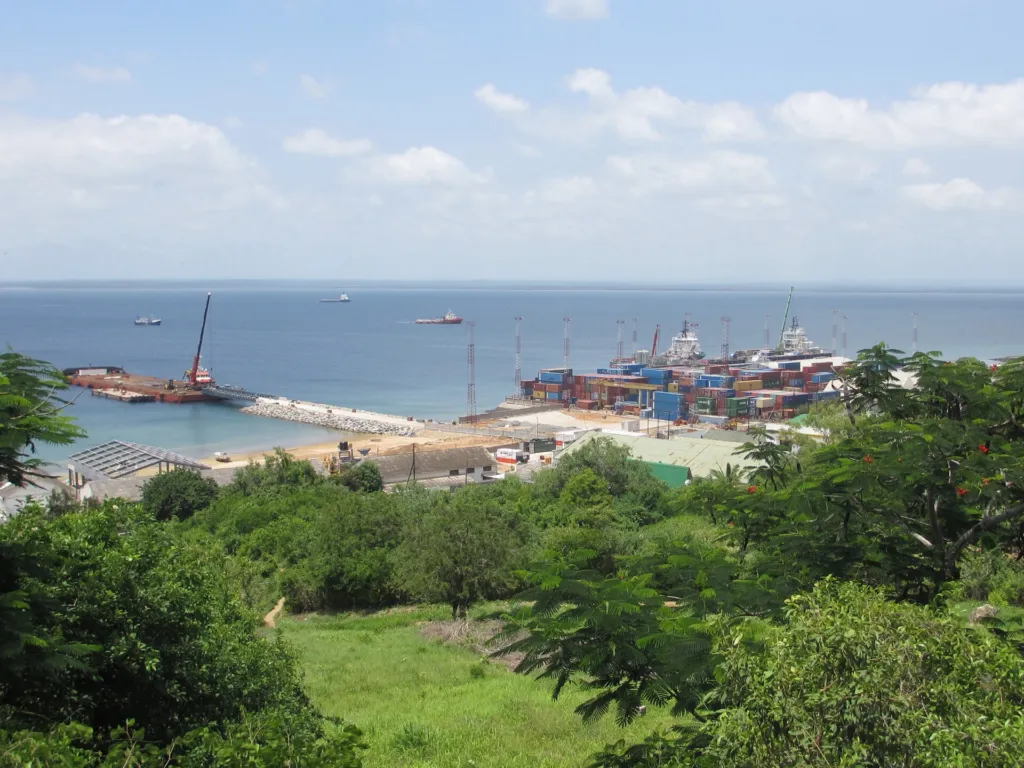
Top photo: The port of Pemba, Cabo Delgado’s provincial capital, which grew after the gas discoveries (file photo). Photo: Ton Rulkens, Wikimedia Commons, CC BY-SA 2.0
