
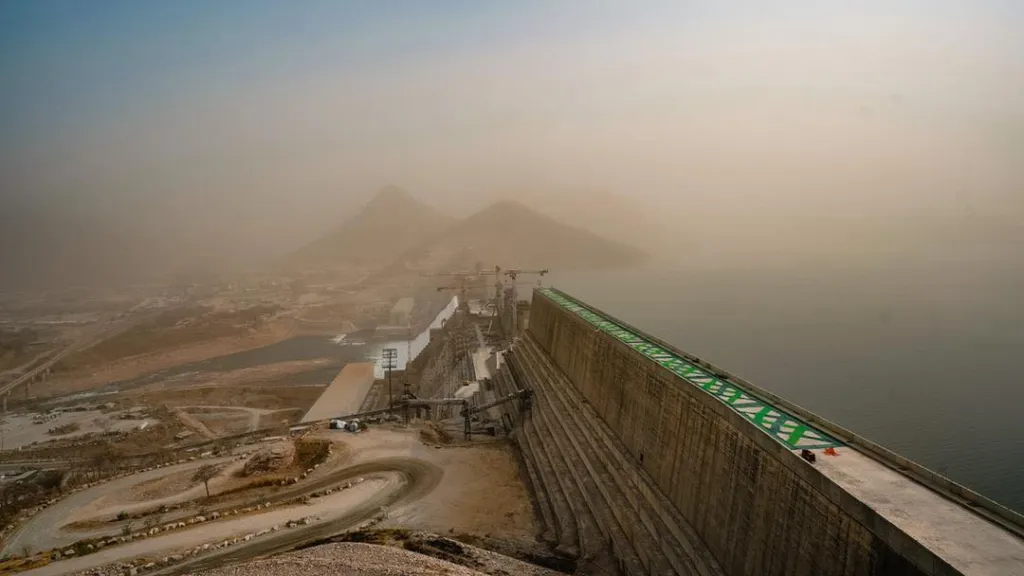
GERD turns Ethiopia into East Africa’s power exporter
The Grand Ethiopian Renaissance Dam (GERD) on the Blue Nile has changed Ethiopia’s electricity sector in a single year. Africa’s largest hydropower plant is now the backbone of the national grid and the main engine of a growing power export business.
GERD in figures
- Capacity. Ethiopia’s installed capacity is about 9,760 megawatts (MW), including about 5,150 MW at GERD, according to Ecofin Agency.
- Share of supply. GERD produced about 51 percent of Ethiopia’s electricity in the first half of the current Ethiopian fiscal year.
- Exports. Power export earnings have risen above half a billion dollars, and GERD accounts for about 52 percent of that export revenue, according to the state utility, Ethiopian Electric Power (EEP).
- Profit. EEP says it moved from a heavy debt burden to profitability in the last fiscal year, with record revenue. Domestic electricity sales exceeded 124 billion birr.
Who buys Ethiopia’s power
Ethiopia exports electricity to Kenya, Djibouti and Sudan, and more recently to Tanzania, through the Eastern Africa Power Pool. Exports make up roughly 6.5 to 10 percent of Ethiopia’s electricity production.
In September, EEP said peak-hour exports to Kenya would double from 200 MW to 400 MW from December 2026. Tanzania receives about 100 MW on a pilot basis, routed through Kenya’s grid.
For importing countries, Ethiopian hydropower is often cheaper than running diesel or gas plants. For Ethiopia, which is short of foreign currency, dollar earnings from electricity are increasingly valuable.
The downstream question
Egypt and Sudan have long objected to the dam, fearing it would reduce their share of Nile water, particularly during droughts. Ethiopia filled and inaugurated the dam without a binding agreement with its downstream neighbours. Addis Ababa says GERD regulates the river’s flow and provides a steadier supply downstream. Egypt continues to call for a legally binding deal on how the dam is filled and operated.
Exports to Kenya from December
- The start of 400 MW exports to Kenya in December.
- New interconnections to Tanzania, South Sudan and beyond.
- Relations with Egypt and Sudan, especially in dry years.
- Whether export revenues are reinvested in Ethiopia’s domestic grid.
Sources: Ethiopian News Agency via AllAfrica, 14 September 2026; Ecofin Agency, 17 September 2026; POWER Magazine; Mongabay; Capital Ethiopia, 15 September 2026.
Top photo: The Grand Ethiopian Renaissance Dam on the Blue Nile, 2022 (file photo). Photo: Office of the Prime Minister of Ethiopia, Wikimedia Commons, Public domain
