The Gambia votes on 5 December: what to know about the presidential race
Gambians go to the polls on 5 December to choose a president, in the second presidential election since Yahya Jammeh’s 22-year rule ended in 2017. The contest will test whether President Adama Barrow can win a third term, and whether a divided opposition can stop him.
The incumbent
Adama Barrow, 61, came to power in January 2017 after winning the December 2016 election as the candidate of an opposition coalition that unexpectedly defeated Jammeh. He promised to serve a three-year transitional term, then stayed on, formed his own National People’s Party (NPP) and won re-election in 2021 with 53 percent of the vote.
He is allowed to run again because The Gambia’s constitution has no presidential term limit. A new draft constitution that would have introduced a two-term limit was rejected by the National Assembly in September 2020, when it fell short of the three-quarters majority needed to send it to a referendum. Critics noted that the draft would have counted Barrow’s first term, ruling him out of this year’s race. The constitution question has hung over Gambian politics ever since.
Barrow’s campaign highlights new roads, bridges and electricity projects, and the peace the country has enjoyed since the transition. His opponents point to rising public debt, the cost of living and the stalled constitutional reform.
The challengers
Ousainou Darboe leads the United Democratic Party (UDP), the largest opposition party. A veteran lawyer and long-time opponent of Jammeh, he briefly served as Barrow’s vice-president before the two fell out. He finished second in 2021 with 28 percent and is campaigning on constitutional reform and accountability.
Talib Ahmed Bensouda, mayor of Kanifing Municipal Council since 2018, leads the newer UNITE movement. Younger than the main rivals, he is pitching himself to young and urban voters with promises of jobs, digital reform, reliable water and electricity, and less centralised government. He has linked job creation directly to reducing irregular migration, a deeply personal issue in a country that has lost many young people on the dangerous journey to Europe. On 31 October a government white paper on a local government inquiry recommended his removal as mayor, citing misconduct findings that include a 10,000 dalasi honorarium he received in 2018. UNITE called it “a weak, last-minute political manoeuvre intended to confuse the public” and said his nomination would go ahead, AFP reported.
Other contenders include Mamma Kandeh of the Gambia Democratic Congress, who took 12 percent in 2021, and independent National Assembly member Bakary K. Badjie.
What the polls say
Opinion polling is limited, but a survey by the civil-society group Gambia Participates, reported in August, put Barrow on 32 percent, Darboe on 25 percent and Bensouda on 19 percent, with about one voter in six still undecided. Instead of uniting behind one candidate, the opposition has formed three rival coalitions: Gambia First, led by Darboe’s UDP; Coalition 2026, which chose Bensouda as its candidate; and Team Gambia, launched in September by Halifa Sallah and Sidia Jatta of PDOIS. The outcome may depend on how the opposition vote splits, and on where the undecided voters go.
That matters because The Gambia uses a simple first-past-the-post system with no run-off: whoever wins the most votes becomes president, even without a majority.
Nominations opened on 3 November, with about 25 people saying they want to run. Candidates are filing their nominations with the Independent Electoral Commission between 3 and 11 November, with 13 and 14 November set aside for corrections. UNITE is due to file on 7 November, the UDP on 9 November and Barrow’s NPP on 10 November, with campaigning to follow.
Voting with marbles
The Gambia is famous for one of the world’s most distinctive voting systems. Instead of paper ballots, voters drop a glass marble into a sealed drum painted in their chosen candidate’s party colours and marked with the candidate’s photograph. A bell inside rings as the marble falls, so officials can hear that exactly one vote has been cast.
The system was designed to make voting easy for everyone, including those who cannot read, and it makes counting fast. Results are usually known the day after the vote.
What to watch
- Opposition unity: whether the three opposition coalitions stay apart or join forces before polling day.
- Turnout among young voters: a large share of the electorate is under 35, and Bensouda’s campaign depends on them.
- The constitution: whatever the result, the next president will face renewed pressure to deliver the new constitution and presidential term limits.
- A peaceful process: The 2016 and 2021 elections were widely judged credible, and regional partners will be watching for the same in December.
Fifty4 News will report the results as they come in.
Sources: Independent Electoral Commission of The Gambia; Dubawa, 17 July 2026; Gambia Participates poll, August 2026; 2021 official results; The Rio Times, 21 September 2026; The Rio Times, 30 October 2026; EWN/AFP, 31 October 2026; The Point, 4 November 2026.
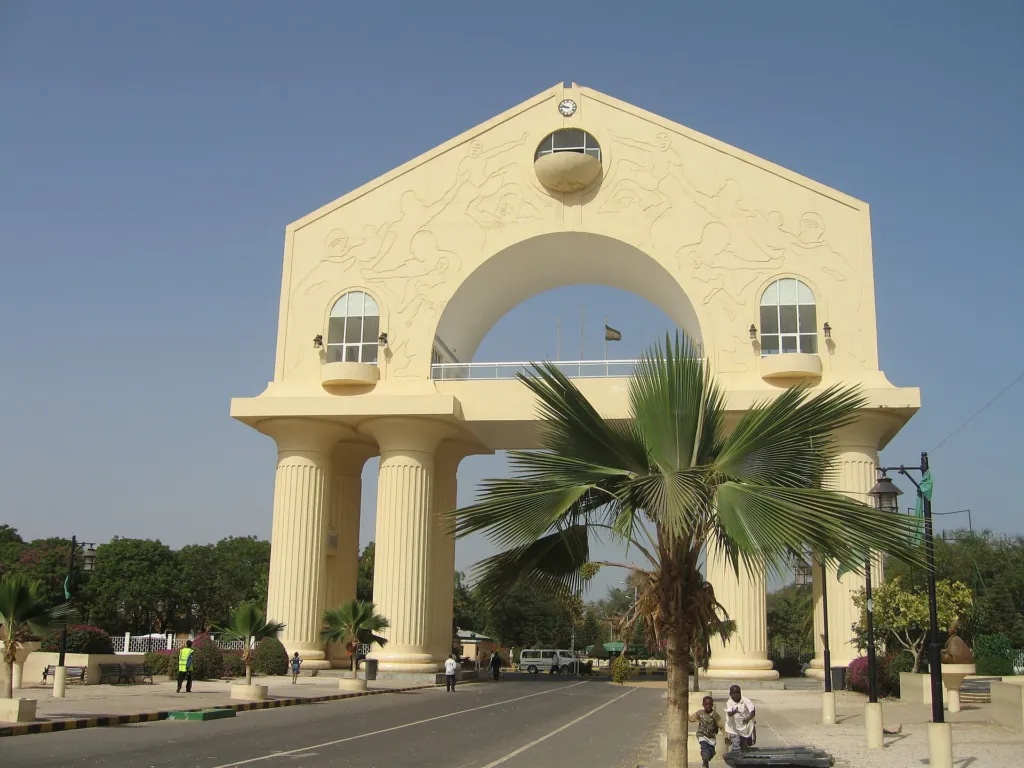
Top photo: Arch 22 in Banjul, The Gambia. Photo: Travel Local, Wikimedia Commons, CC BY 2.0
