
Four days after TraffiTech-GH went live in Ghana, what we have learned
Ghana’s automated speed enforcement system, TraffiTech-GH, went live on Sunday 1 November. Speeding drivers are now caught on camera and fined by text message, without being stopped at the roadside. Four days in, it has changed how some people drive in Accra and run into a dispute with commercial drivers’ unions, who called off a nationwide strike planned for today, Wednesday 4 November, after talks with government ministers. The bigger question is whether it will make the roads safer.
Why speed is the target
Road crashes killed 2,949 people in Ghana in 2025, according to National Road Safety Authority figures cited by Citi Newsroom. Greater Accra accounted for 420 of those deaths, and 54 per cent of them involved motorbikes.
“Speed kills, and the new system is aim-focused at addressing reckless driving,” ACP Alexander Kwaku Obeng, Director of Education, Research and Training at the police Motor Traffic and Transport Department (MTTD), told Rainbow Radio. “Our objective is to help save human lives and make our streets safe.”
At launch the system covers speeding only, at locations the MTTD says are prone to crashes. The limits are 30 km/h near schools, markets, hospitals and places of worship, 50 km/h in towns, 90 km/h on highways and 100 km/h on motorways. Police say a missing speed sign is not a defence.
What the first days showed
The police have not said how many fines have been issued or what they are worth. ACP Obeng told Joy FM’s Super Morning Show on 2 November that the offences recorded on the first day were “in the thousands”, but he declined to say how many tickets had been sent. Some drivers were clocked at more than 130 km/h on Mahama Road, where the limit is 50 km/h. “The recordings have exposed severe indiscipline on our roads,” he told Rainbow Radio.
Behaviour seems to be changing, at least where people expect cameras. “Everyone is driving like a snail. I can’t even go over 75,” broadcaster Saddick Adams said in a video of the N1 towards Dzorwulu junction. TV presenter Berla Mundi wrote on X: “The fear of Traffitech Gh is the beginning of slow driving.”
Fines run from 20 to 40 penalty units, roughly GH₵240 to GH₵480, depending on how far over the limit the vehicle was, YEN reports. Owners have 14 days to pay or contest a notice, after which 1 per cent of the fine is added for each day it stays unpaid.
How to pay, and how other countries do it
In Ghana, owners pay on the TraffiTech-GH payment website with the ticket number, by card or mobile money (MTN, Telecel or AirtelTigo), or by dialling *710*0#, which works on a basic phone. The police say fines must never be paid to an officer in cash or to a personal number. Other African countries that use cameras handle payment differently:
- Rwanda. Fines are paid through Irembo, the government services portal, on its website, app or USSD code *909#. A billing number is generated and paid by MTN or Airtel mobile money, Bank of Kigali or card. Police say fines are due within three days, with a late fee after that.
- Kenya. Speeding and red-light fines from the National Transport and Safety Authority (NTSA) must be paid in person at a KCB bank branch or agent within seven days. NTSA Director General Nashon Kondiwa told The Star the teller acts as a “third eye” against fake SMS links. A Nairobi lawyer, Donald Kipkorir, has questioned why the money goes into a private bank account.
- Lagos, Nigeria. Camera fines are notified by SMS, and owners can look up and pay outstanding offences on the state’s PayVIS website by entering their number plate.
Ghana’s 14-day window is longer than Rwanda’s and Kenya’s, and, like Rwanda, it lets drivers pay by mobile money without visiting an office or bank.
The drivers’ dispute
Five groups, including the Ghana Private Road Transport Union (GPRTU) of the TUC, had called a strike for today. Their complaint is less about the cameras than about traders who occupy bus stops and walkways. “We cannot operate in bus stops occupied by traders and still be fined by cameras,” their notice said. The GPRTU’s deputy public relations officer, Samuel Amoah, told Adom FM: “We are not against TraffiTech or the enforcement of speed limits. We support the initiative fully.”
ACP Obeng rejected linking the two. “We should not mix the issues up,” he told Adom FM, adding that other offences would still be enforced manually.
The strike was called off after the GPRTU and the Ghana Road Transport Coordinating Council (GRTCC) met government ministers, including the Interior Minister, on 3 November. Samuel Amoah told 3News that officials had agreed to clear traders from bus stops and pedestrian walkways by the end of November. “That is why we have called off the strike, pending the intervention of the relevant stakeholders to address our concerns,” he said. In a statement, the unions said they expected their concerns to be addressed within 30 days and warned that they would otherwise strike.
What to watch
- The 30-day deadline. Whether the government clears traders from bus stops and walkways as promised. The unions say they will strike if their concerns are not addressed within 30 days.
- Crash data. Whether the police publish crash figures, camera locations and fine revenue, as commentators at Techlabari and Citi Newsroom have urged, so the public can judge whether the system saves lives.
- Fairness. Owners are liable whoever was driving, and the same commentaries warn that out-of-date vehicle records could send fines to the wrong people.
How the system works, from camera to mobile money payment, is explained in our companion piece, “How TraffiTech-GH works”.
Sources: 3News, 1 November; Citi Newsroom, 3 November; Rainbow Radio, 3 November; MyJoyOnline, 2 November; YEN, 2 November; YEN, 3 November; Pulse Ghana, 2 November; MyJoyOnline, 31 October; Adomonline, 2 November; Adomonline, 2 November; Techlabari; Irembo; Rwanda National Police; The Star, 1 July; Nairametrics, 17 January 2021; BusinessDay, 7 February 2025; MyJoyOnline, 4 November; 3News, 4 November; Ghana Police Service, TraffiTech-GH page.
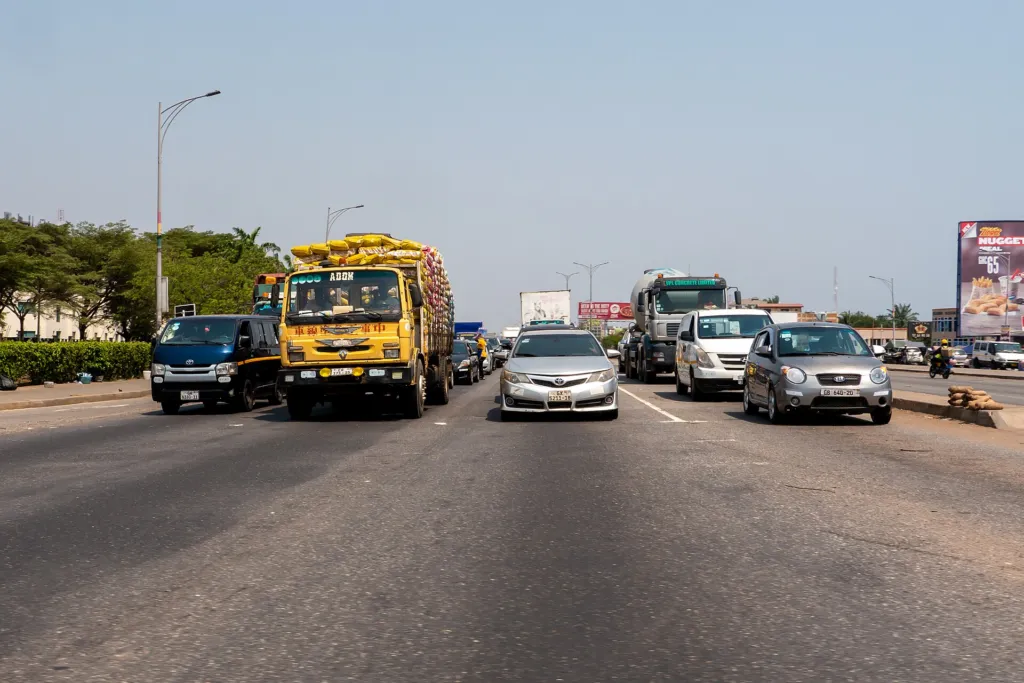
Top photo: Traffic at the junction of the George Walker Bush Highway (N1) and the Legon Bypass in Accra (file photo). Photo: Matti Blume, Wikimedia Commons, CC BY-SA 4.0
