
Ebola reaches Kenya: how East Africa is responding
For months, Ebola was a crisis in eastern Congo. In October it became an East African problem.
Kenya confirmed its first case on 6 October, after a Kenyan man who had lived in the Democratic Republic of Congo for seven years died in Nairobi. Since then, Kenya has recorded further infections, Uganda has tightened controls on travellers from Congo, and Nigeria has confirmed a case far to the west.
Kenya’s first case
According to Health Cabinet Secretary Aden Duale, the man had been ill for about a month. He travelled by road from Congo to Kampala, then flew to Nairobi on 3 October, where he died two days later.
The response began immediately:
- Health officials identified close contacts, including family members and health workers who cared for him.
- They began tracing 23 passengers and four crew members on the flight from Uganda.
- President William Ruto said at least eight family members and 21 health workers had been quarantined, and ordered an enhanced national response.
- Contacts are isolated for 21 days and released only if they test negative, said Patrick Amoth, director-general of the Ministry of Health.
By 20 October, Kenya had recorded nine infections, according to news reports citing health officials.
Uganda’s quarantine order
Uganda, which recorded 20 cases and two deaths earlier in the year before being declared Ebola-free in August, has ordered a mandatory 21-day quarantine for students travelling from Congo. The country sits on the main road and air routes out of eastern Congo, which makes it both a buffer and a transit point.
Why this outbreak is so dangerous
The outbreak, declared in Congo on 15 May, is caused by the Bundibugyo strain of Ebola, for which there are fewer vaccines and treatments than for the more common Zaire strain. By mid-October it had infected more than 9,000 people and killed more than 4,300, and the World Health Organization described it as the fastest-spreading Ebola outbreak on record.
Much of the spread has been in conflict-hit areas of eastern Congo, including camps for displaced people where fatality rates have been especially high.
Lessons from the past
East Africa has dealt with Ebola before. Uganda has contained several outbreaks, including a Sudan-strain outbreak in 2022–2023, and its health workers are among the most experienced on the continent. Kenya’s response has drawn early praise from public health experts for its speed in tracing contacts.
The WHO has advised against travel and trade restrictions on Kenya, Congo and Uganda, warning that bans can push travellers to avoid official border points and make cases harder to track.
What the public should know
- Ebola spreads through direct contact with the blood or body fluids of a sick person, or the body of someone who has died from the disease. It is not airborne.
- Early symptoms include sudden fever, fatigue, muscle pain and headache, followed by vomiting and diarrhoea.
- Anyone with these symptoms after travel to an affected area, or after contact with a suspected case, should contact health authorities before going to a clinic, so staff can prepare.
What to watch
- Whether Kenya’s cases remain linked to the first patient, or whether new chains of transmission appear.
- Screening at Jomo Kenyatta International Airport and land borders with Uganda.
- Vaccine and treatment trials for the Bundibugyo strain, which could change the course of the outbreak.
Sources: Al Jazeera, 6 October 2026; NPR/AP, 20 October 2026; Rio Times, 26 October 2026; Kenya Ministry of Health.
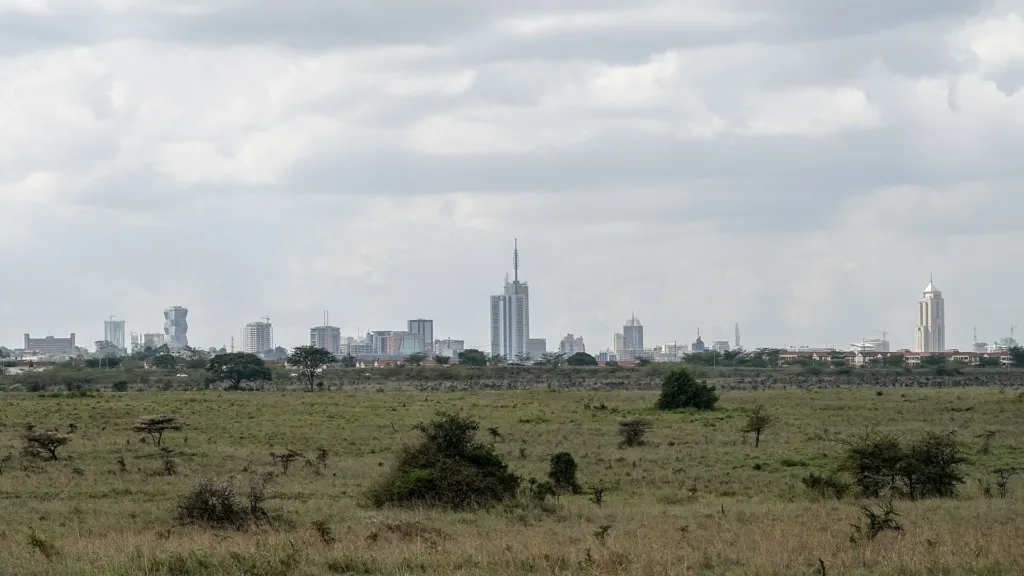
Top photo: The Nairobi skyline seen from Nairobi National Park (file photo, 2019). Photo: Timothy A. Gonsalves, Wikimedia Commons, CC BY-SA 4.0
