
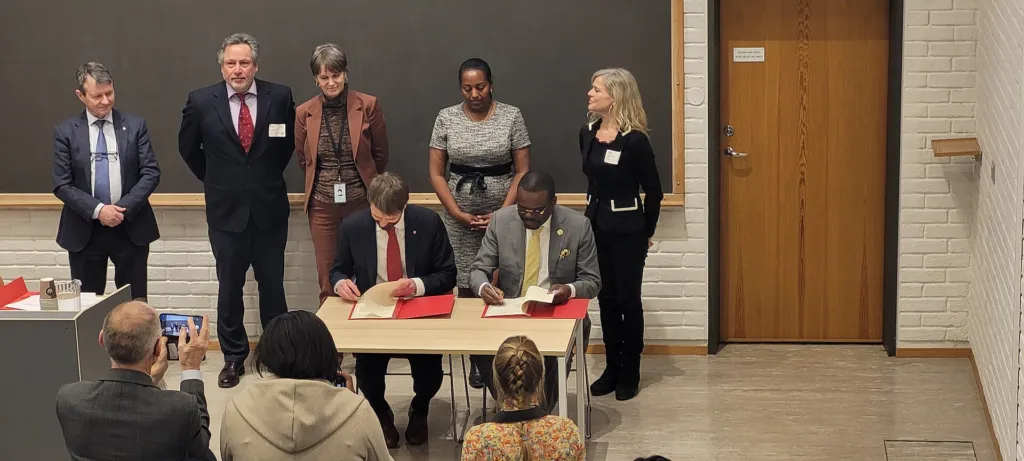
Jean Kaseya: the doctor leading Africa’s fight against Ebola
As Ebola spreads from eastern Congo to Kenya and Nigeria, one of the voices Africans hear most is that of Dr Jean Kaseya, director general of the Africa Centres for Disease Control and Prevention (Africa CDC). He has described the outbreak as “extremely serious”. For Kaseya, it is also personal: the epidemic began in his home country.
From Kinshasa to the world
Kaseya was born in Kinshasa, in what is now the Democratic Republic of Congo, in 1970. He trained as a medical doctor at the University of Kinshasa, graduating in 1997, and later earned a master’s degree in public health from Henri Poincaré University in France.
He began his career in Congo’s Ministry of Health, where he worked on routine immunisation, and served as a senior health adviser to the presidency until 2001. He then led projects funded by the US Agency for International Development in Congo for several years.
A career in vaccines
Kaseya’s career has been closely linked to vaccines:
- At the World Health Organization in Geneva, he was technical coordinator for the Meningitis Vaccine Project, helping to develop a $571 million investment plan that supported MenAfriVac, a vaccine that dramatically reduced meningitis A epidemics across Africa’s “meningitis belt”.
- At Gavi, the Vaccine Alliance, he served as a senior programme director.
- At UNICEF, he spent about nine years in senior roles in Côte d’Ivoire, the Republic of Congo and Namibia.
- At the Clinton Health Access Initiative, he led its African diagnostics work and its Congo office.
Leading Africa CDC
In April 2023, Kaseya became director general of Africa CDC, the African Union’s public health agency. He was the first to be elected to the post by African heads of state.
Africa CDC was set up in 2017 to help African countries detect, prevent and respond to disease outbreaks, and its profile rose sharply during the Covid-19 pandemic. Under Kaseya, it has pushed for Africa to rely less on outside help, especially for vaccines and medicines.
He led the development of the African Pooled Procurement Mechanism, endorsed by the African Union in 2024, which allows countries to buy health products together and encourages local manufacturing. It supports the African Union’s goal of producing at least 60 percent of the continent’s vaccines in Africa by 2040, up from a tiny share today.
The Ebola test
The current Ebola outbreak, caused by the Bundibugyo strain and declared in May, has infected more than 10,000 people in Congo alone, and by 31 October the death toll there had passed 5,000, Al Jazeera reported. It is spreading in conflict zones and displacement camps, and has crossed borders: Kenya has reported nine cases and two deaths, Nigeria confirmed its first case on 20 October, and an earlier outbreak in Uganda was declared over in August.
Kaseya has been blunt about the scale of the challenge. On 28 October he said he had told more than 40 African health ministers “what the data tells us: we are not winning so far”, Premium Times reported. “Ebola anywhere in Africa demands preparedness everywhere in Africa,” he added.
For Africa CDC, it is a test of whether the continent’s own institutions can coordinate a response across borders, mobilise funding and speed up access to vaccines and treatments for a strain with fewer tools available.
Why he matters
Kaseya represents a generation of African health leaders who built their careers in global institutions and now want Africa to lead its own health security. How Africa CDC handles this outbreak will shape how much the continent trusts, and funds, that ambition.
Sources: Wikipedia; Africa CDC; NPR/AP, 20 October 2026; European Centre for Disease Prevention and Control, 28 October 2026; World Economic Forum; Premium Times, 29 October 2026; Al Jazeera, 31 October 2026.
Top photo: Africa CDC Director General Jean Kaseya at the signing of an agreement with Norway’s health minister in 2025. Photo: Ahmed0112, Wikimedia Commons, public domain (CC0)
