
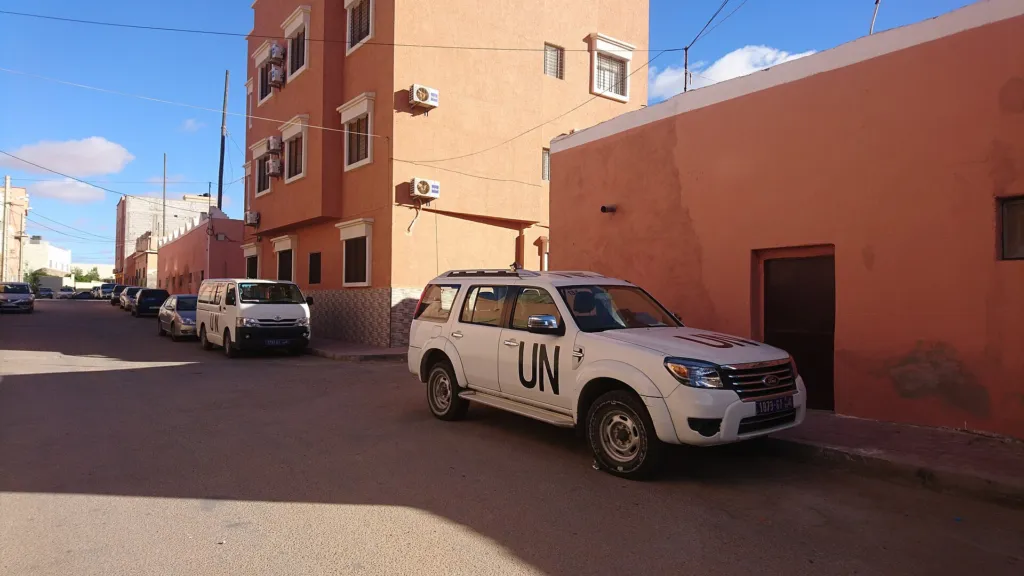
UN mission in Western Sahara ends after 35 years: what happens now?
The United Nations mission that has watched over the ceasefire in Western Sahara for 35 years has come to an end. The mandate of MINURSO expired at midnight on 31 October after the UN Security Council failed to agree on its future, and on 1 November the mission began winding down.
Morocco has welcomed the outcome as a step towards closing the dispute at the UN. Algeria and the Polisario Front, which seeks independence for the territory, have reacted with dismay, and UN Secretary-General António Guterres has warned of “the risk of hostilities escalating”.
What happened at the UN?
On 30 October the Council voted on two rival drafts.
- The US draft would have extended the mission for a year, dropped the word “referendum” from its name and made Morocco’s autonomy proposal the only basis for further talks. It won 11 of the 15 votes, including those of France and the UK, but Russia vetoed it.
- The Russian draft would have renewed the mission unchanged for a year. It won only two votes, with one against and 11 abstentions, short of the nine it needed.
Russia’s ambassador, Vassily Nebenzia, said the Council “cannot automatically predetermine matters relating to sovereignty”. The US ambassador, Mike Waltz, said the American text “would have moved the 50-year conflict forward” and called the status quo unacceptable.
What was MINURSO?
The UN Mission for the Referendum in Western Sahara was set up in 1991 to monitor a ceasefire between Morocco and the Polisario Front and to organise a vote on the territory’s future. That referendum was never held. By the end, the mission had about 200 personnel from more than 35 countries, with its headquarters in Laayoune, nine team sites and a liaison office in Tindouf, Algeria.
Why is Morocco celebrating?
Morocco has controlled most of Western Sahara since Spain withdrew in 1975 and regards it as part of the kingdom. Its 2007 plan offers the territory self-government under Moroccan sovereignty. In 2020 the United States recognised Moroccan sovereignty, and in October 2025 the Security Council backed the autonomy plan as the basis for negotiations.
In a statement on 30 October, Morocco’s royal cabinet said the mission’s presence “should come to an end in the coming days” and that the kingdom “remains firmly committed to the ceasefire”, Morocco World News reported. It said similar steps would follow “within other UN bodies”. Rabat wants the issue taken off the Council’s agenda altogether.
Selim Balouati Lakhloufi, a historian based in Morocco, told Al Jazeera that “the proposal for autonomy could end up becoming the main framework for negotiations”.
What do Algeria and the Polisario say?
The Polisario Front declared the Sahrawi Arab Democratic Republic in 1976 and, with Algeria’s backing, wants a referendum that includes the option of independence. It resumed its armed struggle in 2020, and low-level fighting has continued since. At least 170,000 Sahrawis live in refugee camps around Tindouf.
The Polisario’s UN representative, Sidi Omar, welcomed Russia’s veto, arguing that the US draft would have undermined Sahrawi self-determination. Algeria’s foreign ministry expressed “deep regret” at the failure to renew the mandate and called the US text “excessively and blatantly favorable to the Kingdom of Morocco, to the detriment of the Polisario Front”, the Moroccan news site Yabiladi reported.
What are the risks now?
Without UN observers, no neutral body is left on the ground to check reports of ceasefire violations. Guterres urged all sides to “exercise maximum restraint”. He said the mission’s departure “does not abrogate” the Sahrawi people’s right to self-determination and that the UN “stands ready” to support dialogue. His personal envoy, Staffan de Mistura, stays in post.
The aid group Oxfam warned that losing the mission’s “monitoring and de-escalation functions risks undermining security and stability”.
Key dates
- 1975. Spain withdraws; Morocco takes control of most of the territory.
- 1976. The Polisario Front declares the Sahrawi Arab Democratic Republic.
- 1991. A UN-brokered ceasefire takes effect and MINURSO is created.
- 2007. Morocco presents its autonomy plan.
- 2020. The Polisario resumes its armed struggle; the US recognises Moroccan sovereignty.
- October 2025. The Security Council backs autonomy as the basis for talks.
- 31 October 2026. MINURSO’s mandate expires without renewal.
Sources: Al Jazeera, 31 October; Al Jazeera, 1 November; Al Jazeera, 1 November; UN News, 1 November; Morocco World News, 30 October; Yabiladi, 31 October.
Top photo: A UN mission vehicle on a street in Laayoune, Western Sahara, in 2019 (file photo). Photo: Anass Sedrati, Wikimedia Commons, CC BY-SA 4.0
