
“AI Made in Morocco”: the kingdom’s $10 billion bet on artificial intelligence
Morocco wants to be a producer of artificial intelligence, not just a consumer. Its “AI Made in Morocco” strategy, launched in January and now moving into implementation, is one of the most ambitious in Africa.
The targets
By 2030, the plan aims to:
- Add 100 billion dirhams (about $10 billion) to GDP.
- Create 50,000 direct and indirect AI-related jobs.
- Train and certify 200,000 people in AI skills.
Digital Transition Minister Amal El Fallah Seghrouchni, an AI researcher by training, presented progress in Rabat on 8 September. The government describes its approach as a “third way” between dependence on foreign AI and isolation.
JAZARI institutes
A key element is a network of AI centres called JAZARI Institutes, named after the medieval engineer Al-Jazari. The founding decisions were published in the Official Gazette in August. The central hub, JAZARI ROOT, is in Rabat, with institutes focused on education, industry and smart cities, and plans to cover all 12 regions.
The money is now in the budget. Morocco’s draft 2027 finance bill sets aside 1.34 billion dirhams (about $145 million) for artificial intelligence, of which 1.08 billion is for investment, TelQuel reported on 5 November. It covers the first three JAZARI institutes and a 50 MW sovereign data centre planned for 2027 to 2029. Parliament still has to approve the bill.
Home-grown tools
The government is developing AI tools for public services, including:
- Idarati AI, to guide citizens through administrative procedures.
- Legal tools to help people navigate texts in the digitised Official Gazette.
Morocco is also building language models for Darija, the Moroccan Arabic dialect, and Amazigh, which are poorly served by global AI systems.
Infrastructure and partners
- Nearly 1 gigawatt of planned data centre capacity, including a 50 MW sovereign cloud near Rabat and a 500 MW renewable-powered complex planned in Dakhla.
- A National Data Factory to prepare public data for AI, and a software platform to share government code.
- Partners including France’s Mistral AI, with which a joint lab is planned, as well as Nokia, Orange Business and Oracle.
How Morocco compares
Morocco has strengths: renewable energy, undersea cables to Europe, and a growing tech sector. But AI use is still limited. A Microsoft report estimated that 11.7 percent of Moroccan working-age adults used AI tools in early 2026, slightly behind Algeria.
JAZARI institutes and Darija models
- The opening of JAZARI institutes in the regions.
- Progress on the Darija and Amazigh language models.
- Investment in the planned data centres.
Sources: Middle East AI News, 13 January 2026; Ecomnews Med; iAfrica; Hespress, 9 September 2026; Le Matin, 9 September 2026; Finances News Hebdo, 2 August 2026; Morocco World News, August 2026; Maghreb Émergent, 24 May 2026; TelQuel, 5 November 2026.
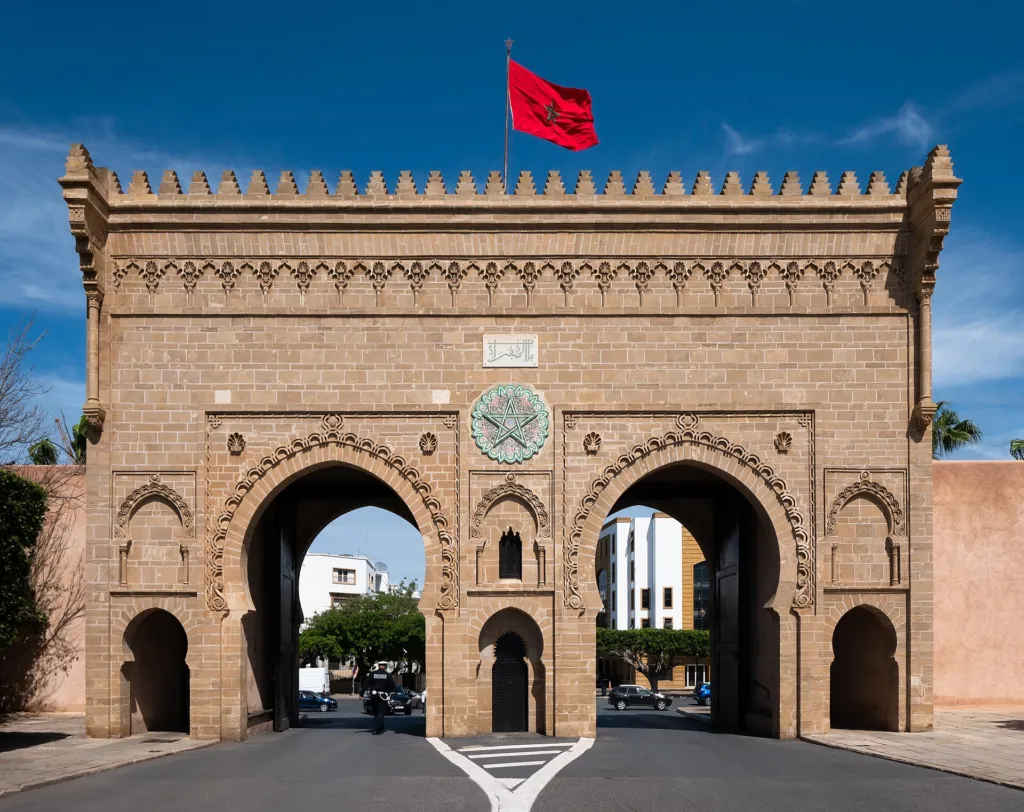
Top photo: The Bab al Soufara gate in Rabat, Morocco’s capital (file photo). Photo: Petar Milošević, Wikimedia Commons, CC BY-SA 4.0
