
Why Tullow’s share price in Accra has not followed London lower
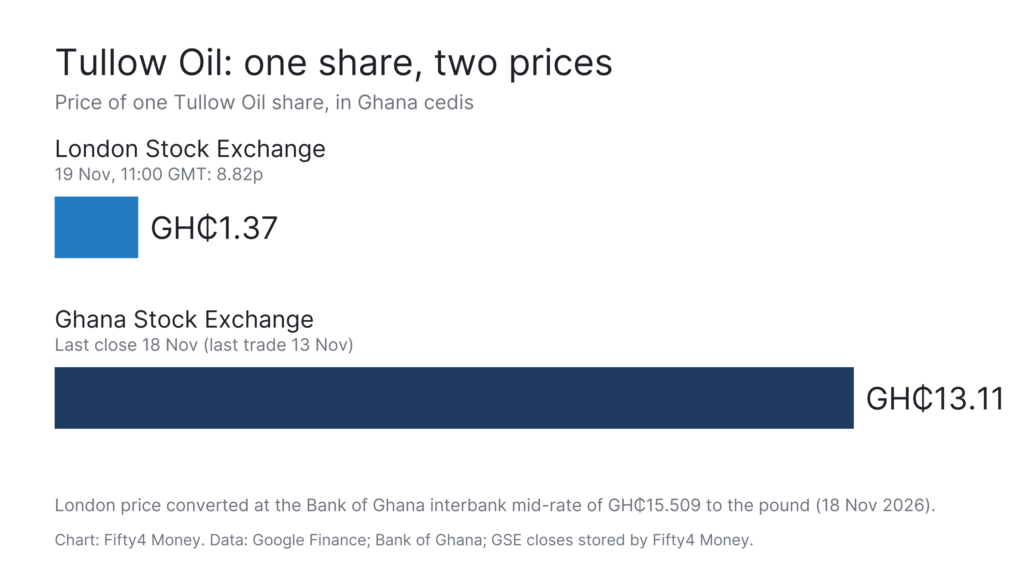
If you hold Tullow Oil shares on the Ghana Stock Exchange (GSE), the exchange will tell you each one is worth GH₵13.11.
In London, where the same company’s shares change hands all day, the market puts them at about GH₵1.33.
Same company. Same shares. A price in Accra nearly ten times the price in London.
Tullow has been in the news in Ghana since 30 September, when the country won its tax dispute with the oil producer. Tullow puts the assessment it challenged at US$196.5 million. The Ghana Revenue Authority says the tribunal upheld its full assessment of US$393.09 million. In London, the shares have been marked down sharply since. In Accra, the price has not moved.
On 10 November, President John Mahama said the government and Tullow had reached a “mutually acceptable arrangement” on the tax bill, Graphic Online reported. No terms have been published. On 12 November, Tullow told Bloomberg that “constructive discussions” with the government were continuing.
The numbers
At the London close on 20 November, Tullow traded at about 8.62 pence, down from 8.82 pence on 19 November, as we reported earlier. At the Bank of Ghana’s interbank mid-rate of GH₵15.460 to the pound on 20 November, that is roughly GH₵1.33 a share.
On the GSE, Tullow’s last close on 20 November was GH₵13.11.
A price nobody is paying
A share price is only as good as the last trade. In Accra, there has barely been one.
Fifty4 Money keeps a record of every GSE closing price. It shows that 39 Tullow shares changed hands on 13 November. Since then, not a single share has traded. Our record starts on 13 November, so it cannot say how long the price has stood at GH₵13.11.
In London, buyers and sellers trade the stock continuously, and the price moved quickly after the tax ruling.
The problem is not new. In a 2024 essay, the Ghanaian policy analyst Bright Simons, of the think tank IMANI, wrote that Tullow’s GSE price had been stuck since 2018 at the equivalent of about 60 British pence, while the shares traded below 30 pence in London. He estimated that the Tullow shares listed in Accra, worth about US$73 million when they debuted in 2011, were worth about US$2.7 million by then.
The rules that hold the price in place
Even if someone in Accra wanted to trade at London’s price, the exchange’s own rules would not let the price get there quickly.
Under Rule 30 of the GSE’s trading rules, a stock priced at GH₵10 or more can only change price on a trade of at least 500 shares. The 39-share trade on 13 November was too small to move the price, whatever price it was done at.
When a trade is big enough, the price can still rise or fall by no more than 10 per cent in a day. To fall from GH₵13.11 to around GH₵1.33, Tullow would need 22 straight sessions of maximum declines. That is more than a month of trading. Only negotiated trades, worth at least GH₵5 million or 5 per cent of a company’s market value, escape these limits.
The rules exist to stop wild swings and price manipulation on a small market. In Tullow’s case, they also keep a price on the board that is far from what the shares fetch in London.
Why traders cannot close the gap
In a big market, a gap like this would not last long. Traders would buy where the share is cheap, sell where it is dear, and keep the difference until the two prices met.
That is hard to do here. Shares bought in London cannot simply be sold in Accra. Moving them between the two share registers takes time and paperwork through brokers, and the money has to be changed between pounds and cedis. So nothing pulls the Accra price towards London’s.
What it means for holders in Ghana
For anyone holding Tullow on the GSE, GH₵13.11 is a number on a screen, not money in the bank. It is the last price someone paid, not a price anyone is offering today.
To sell, a holder needs a buyer. With London valuing the shares at about GH₵1.33, a buyer in Accra may only come at a much lower price. And because of the 10 per cent daily limit, any fall would come in steps, not all at once.
Fifty4 Money records the closing price of every GSE-listed stock each trading day. See the latest on Fifty4 Money: Ghana.
Sources: Fifty4 News: Tullow Oil shares stay near lows after Ghana wins US$196.5 million tax case; Google Finance (London price); Bank of Ghana daily interbank FX rates; GSE Stock Feed (GSE closes stored by Fifty4 Money); GSE Trading Rules (Rule 30); Citi Newsroom (tax assessment figures); Graphic Online, 10 November 2026; Bloomberg, 12 November 2026; Bright Simons, “Will Ghana’s Stock Market ever work?” (Citi Newsroom, 2024); Fifty4 Money: Ghana
For information only, not investment advice. Speak to an SEC-licensed investment adviser or broker before investing.
Top image: Chart by Fifty4 Money; data from Google Finance, the Bank of Ghana and GSE closes stored by Fifty4 Money.