
Keep your SIM across borders: Burkina Faso signs roaming deals with three neighbours
Telecoms regulators from Burkina Faso, Benin, Côte d’Ivoire and Senegal have signed bilateral roaming agreements intended to let people travelling between the four countries use their usual SIM card for calls, text messages and internet without paying punishing charges. The deals were signed in Ouagadougou on 23 October and are expected to take effect in about three months, according to Agence Ecofin.
The agreements cover Burkina Faso’s links with each of the other three countries and are aimed particularly at traders, students and transport workers who cross borders often and would otherwise have to buy a new SIM card in each country.
A deal among UEMOA regulators
The signing closed the second session of the committee of national digital regulators of the West African Economic and Monetary Union (WAEMU, known in French as UEMOA), held in Ouagadougou from 20 to 22 October. The ceremony was chaired by Aminata Zerbo Sabané, Burkina Faso’s minister of digital transition, posts and electronic communications.
The minister said the agreements would be judged by users’ experience rather than by the signing itself. A traveller, she said, “must be able to reach their loved ones, continue their activities and access the services they need” (translated), reported Sidwaya, the Burkinabè state daily. She added: “The applicable technical and commercial conditions will have to be explained to users” (translated).
What Burkina Faso’s regulator says
Wendlassida Patrice Compaoré, executive secretary of Burkina Faso’s regulator, the Authority for the Regulation of Electronic Communications and Posts (ARCEP), said the signing marked the start of a new phase of implementation and monitoring. “This responsibility commits us to maintaining a permanent dialogue between regulators,” he said (translated), according to Sidwaya.
Mamadu Serifo Jaquite, the WAEMU commissioner for human development, spoke on behalf of the president of the WAEMU Commission. Citing the GSMA, the mobile industry association, he said: “In 2024, mobile technologies and services contributed 220 billion US dollars” (translated) to Africa’s economy, about 7.7% of continental output, a figure the GSMA estimates could reach $270bn by 2030.
The WAEMU Commission has asked for precise implementation timetables, transparent tariffs and checks on service quality, according to Bénin Web TV. For Benin, the deal extends arrangements it already has with Mali, Togo and Côte d’Ivoire, its regulator’s representative, Cédric Balo, said.
A 2017 promise, slowly kept
The Economic Community of West African States (ECOWAS) adopted a regulation on free roaming in 2017, but progress has been uneven, Agence Ecofin reported.
- Ghana and Côte d’Ivoire. The first to launch, on 14 June 2023. Charges for Ivorian subscribers in Ghana fell by up to 90%.
- Benin and Togo. Their agreement took effect on 1 January 2024; Ghana joined both in October 2024.
- Liberia and Sierra Leone. Launched in August 2025.
- Benin, Senegal and Togo. Roaming made official in April 2026.
- The Sahel. Burkina Faso, Mali and Niger agreed a roaming deal in November 2024 under their Confederation of Sahel States, with operation announced for January 2025.
By February 2026, more than half of ECOWAS member states had put at least one bilateral agreement into practice.
Why roaming deals stall
Regional bodies have repeatedly flagged obstacles: the technical and financial demands of cost modelling, sharing revenue between operators, fraud, flexible data pricing and protecting customers from surprise bills. Several earlier agreements, such as Mali’s with Benin and Togo signed in December 2023, have not been confirmed as working.
Live within three months?
- Whether the three new agreements go live within the expected three months.
- The tariffs operators publish, and whether they are clearly explained to customers.
- How WAEMU measures progress on usage and prices.
- Whether more roaming links follow between the Sahel states and their coastal neighbours.
Sources: Sidwaya, 26 October 2026; Seneweb, 25 October 2026; Bénin Web TV, 24 October 2026; Agence Ecofin via OSIRIS, 26 October 2026
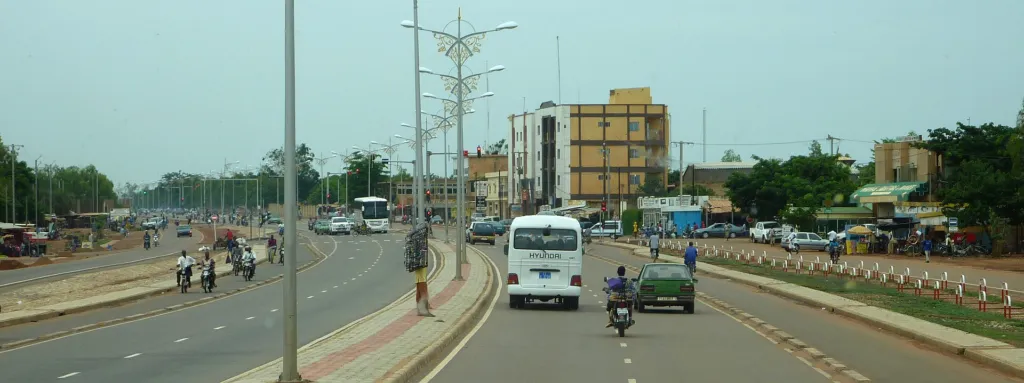
Top photo: A main avenue in Ouagadougou (file photo). Photo: Thigre, Wikimedia Commons, CC BY-SA 4.0
