
Seychelles holds more internet addresses than Ghana. Inside the fight over Africa’s internet registry
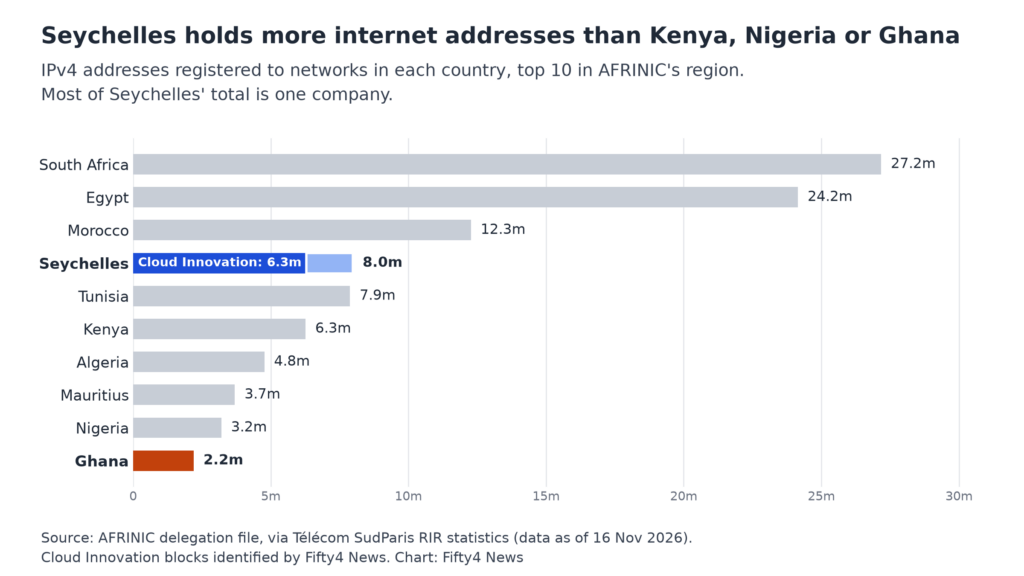
Ghana, a country of more than 30 million people, has about 2.2 million IPv4 internet addresses registered to its networks. Seychelles, one of Africa’s smallest countries, has almost 8 million. That puts the island nation fourth in AFRINIC’s region, ahead of Kenya, Nigeria and Ghana, according to AFRINIC’s public delegation records.
Most of the Seychelles total sits in four blocks issued between 2013 and 2016 to a single company, Cloud Innovation, which is registered in Seychelles and controlled by the Chinese entrepreneur Lu Heng. Together the four blocks hold 6,291,456 addresses, almost three times every IPv4 address held by networks in Ghana.
The figures show where addresses are registered, not where they are used. Cloud Innovation, which reproduced the calculation from AFRINIC’s latest file, puts its four blocks at 79% of the Seychelles total, and points out that an address registered to Seychelles need not carry traffic there.
Those addresses are at the heart of a legal battle that has run for more than five years. It has left Africa’s internet registry, AFRINIC, under a court-appointed receiver, drawn in ICANN and African governments, and could reach a court hearing early next year on whether the registry should be wound up.
Fifty4 News has reviewed the registry’s records, a court document, published statements from both sides and five years of reporting to piece together how it happened, and what it means for networks in Ghana.
Why these numbers matter
Every device on the internet needs an IP address. AFRINIC, a non-profit based in Ebene, Mauritius, hands them out to about 2,400 members across Africa and nearby island states, from mobile operators and banks to universities. It is one of five regional registries in the world, recognised by ICANN, the body that coordinates the internet’s address system, since 2005.
The older type of address, IPv4, has run out almost everywhere, and the shortage has turned addresses into a traded asset. In 2021 MyBroadband estimated the 6.2 million addresses at the centre of this dispute to be worth about R1.8 billion. TechSpot puts typical transfer prices at about US$50 an address, which would value the blocks at roughly US$300 million. AFRINIC was the last of the five registries to start running out, which is why its rules on who may use its addresses, and where, carry such weight.
The allocation and the dispute
AFRINIC issued the four blocks to Cloud Innovation between July 2013 and September 2016. The registry’s records still list them under Seychelles, and AFRINIC’s database names Cloud Innovation’s support team as the contact on a sub-block Fifty4 News checked.
In June 2020 AFRINIC wrote to the company saying it had breached its registration agreement. In a 2022 statement and on its litigation page, AFRINIC says the addresses were not used for the needs Cloud Innovation had justified, that its records did not match how the addresses were used, and that without a policy allowing out-of-region use or leasing, addresses issued for Africa must be used in Africa. A review by ARIN, the North American registry, said “the overwhelming majority” of the addresses had not been used in Africa, pointing to routes announced in Hong Kong and the United States.
Cloud Innovation denies breaching its agreement or misrepresenting its need for the addresses. In a statement to Fifty4 News, it said AFRINIC’s June 2020 letter relied on a section of its bylaws that deals with who may become a member, and that the rule restricting use of addresses outside the region, section 5.4.6.2 of AFRINIC’s policy manual, only took effect when the IPv4 “soft landing” began on 31 March 2017, after all four blocks were issued. It has asked AFRINIC to identify the clause in force on each allocation date. The company acknowledged that its addresses are used outside Africa, but disputes that this was a breach, arguing that route announcements alone cannot show where users or servers are, or which contract terms apply. Lu Heng has argued that his leasing business puts idle address space to work through clear ownership records and contracts.
Independent analysts have found fault on both sides. Milton Mueller’s Internet Governance Project wrote in 2021 that AFRINIC’s rules did not clearly ban out-of-region use and that its threat to take back all the addresses was out of proportion, but also criticised Cloud Innovation’s litigation as going further than was needed to protect its own interests. Cloud Innovation told Fifty4 News it agrees that taking back all four blocks would have been disproportionate, but rejects the criticism of its litigation, saying it went to court to protect networks already using the addresses.
July 2021: the first shots
On 8 July 2021 AFRINIC’s board ended Cloud Innovation’s agreement and gave it 90 days before the addresses would be withdrawn. Within days the company had a court order stopping that. On 23 July it obtained an order attaching up to US$50 million of AFRINIC’s money in two Mauritian banks, as security for a damages claim. Because AFRINIC held less than that, its accounts were in effect frozen. Cloud Innovation stresses that the figure was a ceiling for security, not a damages award.
A judge set the attachment aside on 15 October 2021. According to AFRINIC, the company also tried to attach the registry’s own unused stock of 6.9 million IPv4 addresses; that application was set aside in September 2021. AFRINIC restored Cloud Innovation’s membership pending appeal, and the company still holds the addresses.
A registry that could not govern itself
The cases multiplied. AFRINIC says Cloud Innovation has brought more than 25 cases in Mauritius and two in Seychelles, and that other companies have filed further suits. On 12 July 2022 the five regional registries wrote to the Mauritian government warning of the harm to AFRINIC’s core work.
Disputes over board elections left almost half the board seats empty. In June 2022 a court restrained the chief executive from acting as a director, and the board could no longer reach a quorum. The chief executive’s contract expired that November and could not be renewed.
In September 2023, on Cloud Innovation’s petition, the Supreme Court of Mauritius placed AFRINIC in receivership, with an official receiver to run it and hold elections. An appeal held things up until October 2024, and in February 2025 the court appointed a new receiver, Gowtamsingh Dabee.
The registry has kept operating. Its accounts for 2025, filed with the Registrar of Companies, show revenue of US$6.3 million, a profit of US$1.4 million and US$13.8 million in cash. The same register extract still lists Mr Dabee as receiver.
A failed election and a forgery inquiry
The board election finally took place in June 2025, and collapsed. Voting was suspended minutes before it closed after members reported votes cast in their names under powers of attorney they said they had never signed. The receiver annulled the result.
ICANN sent the receiver 13 questions to answer within 24 hours and warned that if the answers fell short it could open a compliance review. If AFRINIC failed that review, ICANN said, it could ask another registry to act as Africa’s emergency registry. In August 2026 Mauritius police told The Register that two alleged forgery cases from the election were under investigation. The report did not say who is suspected, and Fifty4 News has seen nothing linking any party named in this story to the disputed votes.
A re-run in September 2025 elected eight directors, chaired by Adewale Adedokun. AFRINIC has named Mike Silber as chief executive from 1 January 2027.
Governments enter the fight
The crisis has drawn in African governments. Smart Africa, an alliance whose board is made up of heads of state from member countries, endorsed a slate of candidates for the re-run, and seven of the eight directors elected were on its list. Smart Africa has also proposed a Council of African Internet Governance Authorities, known as CAIGA, which critics say would place a layer of government authority above AFRINIC’s elected board.
ICANN had committed US$40,000 to the Smart Africa project that produced the proposal. In November 2025 it said it does not endorse CAIGA and that any change to how AFRINIC is governed must be decided by AFRINIC’s members and the African internet community.
2026: transfers, dissolution and a disputed register
Three fights are now running at once.
Transfers. On 4 February 2026 AFRINIC’s board ratified a transfer policy which, according to Cloud Innovation, allows AFRINIC-issued IPv4 addresses to change hands within Africa but not to move to another region’s registry. Cloud Innovation calls it a “locked exit” that removes members’ freedom to leave. In March 2026 another company, Skyconnect, went to court to challenge the policy.
Dissolution. In July 2025 Cloud Innovation petitioned the Supreme Court to wind up AFRINIC. ICANN has joined the case, arguing that the addresses AFRINIC manages are not its assets and could not be shared out in a winding-up. A CircleID report says a hearing is expected in February 2027; we have not seen a court order setting that date.
Membership. On 28 October 2026 AFRINIC found Cloud Innovation listed as a member of the company on Mauritius’s official register, with effect from 9 October. Membership matters: members of the company have legal rights over how it is run. In a statement on 31 October, AFRINIC said the entry was made without its knowledge and ignored a ruling of 19 June 2025, in an application brought by ICANN, which AFRINIC says described Cloud Innovation as “simply a resource member”. The published extracts of that ruling refer to a “wrong classification” of Cloud Innovation at the Registrar of Companies, which they say the receiver had remedied. The receiver served a legal notice demanding its removal, copied to the Prime Minister, the ICT minister, the Attorney General and the State Law Office.
Cloud Innovation relies on a Supreme Court rule dated 9 October 2026. A certified copy, supplied by Cloud Innovation and seen by Fifty4 News, sets out an order of 11 June 2025, made after lawyers for both sides agreed its terms by letter. The order varies an earlier one from April 2025. It directs that AFRINIC’s register of members be rectified to add Cloud Innovation “as its member in the category of Member”, tells the Registrar of Companies to make the entries, and orders the entries made under the April 2025 order to be removed. Cloud Innovation says the order was made on AFRINIC’s own application; the copy does not name which side applied. AFRINIC’s statement acknowledges the 9 October rule but says it does not mention the 19 June 2025 ruling. Cloud Innovation says that ruling addressed an earlier, erroneous listing in the directors’ category, not its membership.
In statements sent to Fifty4 News, Cloud Innovation said the receiver’s request to government officials breaches the separation of powers, and asked which later court order authorises its removal. In a 3 November press release it said it “reserves all its rights, including as regards contempt of court”.
Three weeks later, the entry was gone. Fifty4 News has seen two official extracts of AFRINIC’s company record. The one issued on 28 October 2026, supplied by Cloud Innovation, lists nine members: the eight directors elected in September 2025, each from 12 September 2025 with a guarantee of 500 rupees, and Cloud Innovation from 9 October 2026 with a guarantee of zero. The extract issued on 20 November 2026, obtained by Fifty4 News, lists only the eight directors. Neither shows when Cloud Innovation’s entry was removed or under what authority.
“The Registrar’s 28 October extract records Cloud Innovation as a member from 9 October. That entry implements the Court’s direction to enter us in the Member category,” the company told Fifty4 News. It maintains that the court settled its right to membership on 11 June 2025, and has asked the Registrar and the receiver to identify the dated document that authorised the change.
The Registrar of Companies, the government office that keeps Mauritius’s company records, explained its position in a written reply to Fifty4 News on 26 November. It said the status of Cloud Innovation in relation to AFRINIC “remains a hotly disputed matter before the local Courts”. The question, it said, is whether a “resource member” such as Cloud Innovation, or an “associate member”, counts as a member under the Companies Act, given that AFRINIC’s constitution does not require either kind to provide a guarantee if the company is wound up.
Until the courts settle that question, the Registrar said, it is acting on legal advice and “adopting the literal and conservative stand” of listing as members of AFRINIC only those required by law to guarantee a contribution to the company’s assets if it is wound up. It said it takes the same approach with every company limited by guarantee on its register. The 28 October extract had recorded Cloud Innovation’s guarantee as zero. The reply did not say on what date the entry was removed.
Fifty4 News asked AFRINIC and its receiver for comment on 20 November 2026, including when and on what authority Cloud Innovation’s entry was removed, and will update this report with any response.
The information war
Readers searching for this story will find a great deal of coverage, and should know who is behind some of it. The Number Resource Society, a lobby group that campaigns against AFRINIC’s handling of the dispute, has close links to Lu Heng’s company Larus, The Register found in 2023; the NRS has said Larus supplied a template for its website. Some of the strongest criticism of Cloud Innovation also comes from people involved in the cases, including the author of the CircleID report above, who has disclosed that he coordinated a brief filed in the dissolution case.
Cloud Innovation has told Fifty4 News that Larus handles commercial IPv4 services for its addresses, and that it, Lu Heng and Larus have a commercial interest in leasing IPv4 addresses. Where this report draws on material from the parties or people involved in the cases, it says so.
What it means for Ghana
Networks in Ghana hold about 2.2 million IPv4 addresses in 157 separate blocks, all issued by AFRINIC, according to the registry’s delegation records. Mobile operators, internet providers, banks and universities depend on AFRINIC’s database to prove the addresses are theirs, and on AFRINIC to approve any new ones.
The outcome of the three fights matters directly to them:
- Records. If AFRINIC were wound up, someone else would have to run the database that shows who holds which addresses. ICANN has already said that if AFRINIC failed a compliance review, it could ask another region’s registry to act as an emergency registry for Africa.
- Transfers. If the February 2026 policy works as Cloud Innovation describes it, a Ghanaian network holding AFRINIC-issued addresses could not sell or move them to a registry outside Africa.
- Supply. AFRINIC’s remaining IPv4 stock is small, so how it treats large holders and reclaimed addresses affects what is left for new African networks.
- Governance. Whether Africa’s registry is run by its members, by governments through a body like CAIGA, or under another region’s supervision is still undecided.
Fifty4 News has asked MTN Ghana and Telecel Ghana how they provide fixed internet addresses to business customers, and whether a business can keep its address if it switches operator. We will report their answers in a follow-up.
What happens next
Mike Silber takes over as AFRINIC’s chief executive on 1 January 2027. The dissolution petition could be heard in February. The police inquiry into the 2025 election continues, and the dispute over Cloud Innovation’s membership remains unresolved. Five years after AFRINIC first wrote to the company, the 6.2 million addresses are still where they were.
How we checked: Country totals come from AFRINIC’s public delegation file as compiled by Télécom SudParis (data as of 16 November 2026). The four Cloud Innovation blocks (154.80.0.0/12, 45.192.0.0/12, 156.224.0.0/11 and 154.192.0.0/11) were identified by size and date and checked against AFRINIC’s registration database. The court rule was supplied by Cloud Innovation. The membership and accounts figures come from Registrar of Companies extracts for AFRINIC (file C49338) issued on 28 October 2026, supplied by Cloud Innovation, and on 20 November 2026, obtained by Fifty4 News.
Sources: AFRINIC statement, 31 October 2026; AFRINIC communiqué on the 19 June 2025 ruling; AFRINIC communiqué, 25 August 2022; AFRINIC litigation FAQ; ARIN, 27 August 2021; Internet Governance Project, 19 August 2021; NRO letter, 12 July 2022; MyBroadband, July 2021; MyBroadband, September 2023; MyBroadband, 17 May 2025; The Register, 26 June 2025; The Register, 27 November 2025; The Register, 27 May 2026; The Register, 27 August 2026; The Register, 3 July 2023; ICANN, 18 November 2025; TechSpot; CircleID, 5 November 2026; CircleID, 30 March 2026; AfroDIG, March 2026; Cloud Innovation: AFRINIC transfer policy; Cloud Innovation press release, 3 November 2026; Télécom SudParis RIR statistics; Supreme Court of Mauritius rule of 9 October 2026 (SC/COM/PET/000275/2021); statements from Cloud Innovation to Fifty4 News, 20 November 2026.
Top image: Chart by Fifty4 News; data from AFRINIC’s delegation file via Télécom SudParis.