
Ethiopia banned petrol cars. Two years on, did the gamble pay off?
In February 2024, Ethiopia took a step widely described as a world first: it stopped importing new and used petrol and diesel cars. Almost three years on, officials count about 140,000 electric vehicles (EVs) on the road, and the state power company has just opened 11 fast-charging stations in six cities. Outside the capital, though, the switch is far from complete.
The bold decision
Transport Minister Alemu Sime announced the policy to a parliamentary committee in Addis Ababa on 6 February 2024: only electric vehicles would be allowed in, Techpoint Africa reported. He pointed to the cost of imported fuel, which Ethiopia reportedly spent about $7.6 billion on in 2023, and to pollution in city centres. At the time the country had about 7,200 EVs among roughly 1.2 million vehicles.
The government did not back down when it overhauled the economy later that year. “Imports of fully-built internal combustion engine passenger cars and three-wheelers are still banned,” the Finance Ministry wrote in July 2024, CleanTechnica reported. In August foreign embassies were told to import only EVs, and early this year the ban was extended to kits for assembling petrol and diesel cars.
Taxes do the rest of the work: completed electric cars pay a 15 per cent tariff, parts 5 per cent and locally assembled kits nothing, Bloomberg reported in February.
Where things stand
- Fleet. About 140,000 EVs, according to the Ministry of Transport, up from about 7,200 when the ban was announced. Independent figures are rare.
- Share. EVs went from under 1 per cent to nearly 6 per cent of vehicles on the road in two years, by government figures, and made up more than 60 per cent of new registrations last year, CleanTechnica reported.
- Factories. About 17 assembly plants now operate; the government wants 60 by 2030.
What is working
- Cheap, home-grown power. The Grand Ethiopian Renaissance Dam alone can produce 5,150 megawatts, and delivered electricity costs about $0.10 per kilowatt-hour, roughly half the price in neighbouring countries, Bloomberg reported.
- Lower running costs. A typical trip costs 700 to 1,000 birr to charge, against 4,000 to 5,000 birr in fuel, Capital reported. Bethelhem Eshetie, a taxi driver, told Bloomberg she had given up her old car because fuel and repairs made it unprofitable: “It was no longer worth it.” She now drives an electric Chang’an.
- Chargers beyond the capital. The Ethiopian Electric Utility (EEU) has opened 11 fast-charging stations in Addis Ababa, Bishoftu, Mojo, Adama, Batu and Hawassa, able to serve 96 vehicles at once. Its chief executive, Getu Geremew, called it “a significant milestone for the utility”. Ethio Telecom runs its own fast-charging hubs, including one in Adama.
- Public buyers. The Addis Ababa city administration has bought 150 electric minibuses and 100 large buses from local assembler BKG, and the state Development Bank of Ethiopia is tendering for electric SUVs, a bus and chargers.
The challenges
- Too few chargers. EEU has only about 14 or 15 stations working, mostly in and around the capital, and most chargers in the country take four to six hours for a full charge.
- High prices. A small BYD Seagull costs about 3.6 million birr (about $23,000) at one Addis Ababa dealer, a lot in a low-income country.
- Power access. Only about 55 per cent of Ethiopians have electricity, World Bank figures show.
- Repairs. Owners have complained of scarce spare parts and few mechanics trained on EVs.
- Will it last? Rose Mutiso of the Energy for Growth Hub told Bloomberg that much of the surge reflects pent-up demand and is unlikely to continue at the same pace.
- Freight is still diesel. Most trade moves by lorry to Djibouti. EEU has signed Huawei and two other Chinese firms to a six-month study on charging heavy electric trucks on that route. “The objective is to electrify the Ethiopia–Djibouti corridor,” Mr Getu told Capital.
What happens next
- EEU wants five times as many stations in and around Addis Ababa within a year, then Mekelle, Bahir Dar, Dire Dawa and other cities.
- The Djibouti corridor study is due within six months.
- The national e-mobility plan targets more than 2,000 public charging points by 2030.
Sources: Techpoint Africa, 8 February 2024; CleanTechnica, July 2024; Citizen Digital, 20 August 2024; Bloomberg via Energy Connects, 18 February; CleanTechnica, 9 April; Ecofin Agency, 10 April; Birr Metrics, 22 October; Capital, 31 October; Dawan Africa, 3 November.
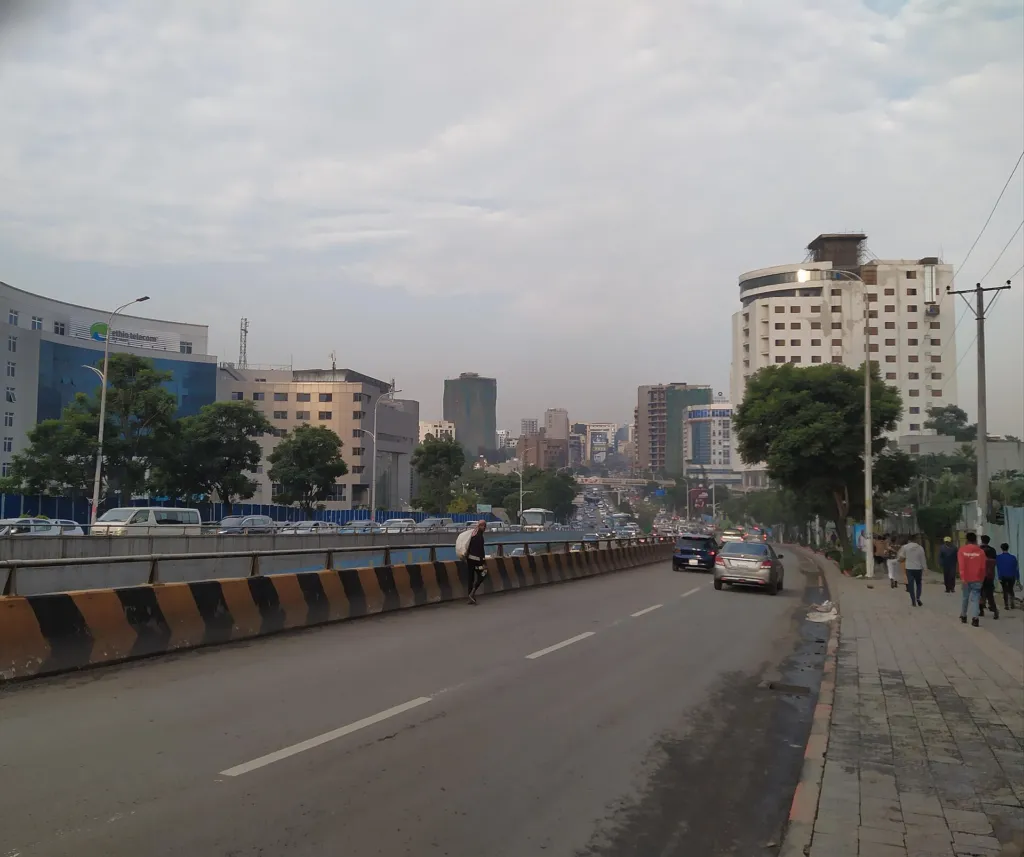
Top photo: Traffic on Bole Road, Addis Ababa, in 2023 (illustrative file photo). Photo: Radosław Botev, Wikimedia Commons, CC BY 3.0 PL
