
Guinea-Bissau delays its election after barring Embaló’s return
Guinea-Bissau’s promised return to civilian rule has stalled. Its military rulers first blocked former President Umaro Sissoco Embaló from returning home. A week later, the government postponed the 6 December presidential and legislative elections that were supposed to end military rule.
Embaló, who was removed in a coup in November 2025, had announced that he would fly back from exile in Morocco and run in the vote scheduled for 6 December. On 1 October, the military high command refused, citing “national security, public order and the need to preserve social stability”. The junta said “security conditions are not in place for his planned arrival.”
The election is delayed
On 8 October, Prime Minister Ilídio Vieira Té told reporters that the elections “will have to be delayed”. He said “there are no conditions for holding the elections scheduled for December 6”, because political parties had not held the congresses needed to choose their leaders and would-be candidates had missed the 6 October deadline to file their candidacies with the Supreme Court. No new date has been set.
How Guinea-Bissau got here
The small West African country of about two million people has a long history of military interference. It has experienced several coups and attempted coups since independence from Portugal in 1974, and few elected leaders have completed a full term.
Embaló was first elected in 2019. In November 2025, the army seized power just days after a presidential vote, before official results were announced. The officers installed Major-General Horta Inta-a as transitional president and promised new elections to restore civilian rule. Embaló left for Morocco, where he has lived since.
Why his return matters
Embaló’s planned comeback puts the junta in a difficult position. If he were allowed to stand and won, the officers who ousted him would face an awkward and possibly dangerous reckoning. Blocking him, on the other hand, undermines the credibility of the very election that is meant to legitimise the transition.
Reaction inside the country has been mixed. Some residents welcomed the ban, arguing that Embaló’s return could inflame tensions. Others see it as a sign that the military intends to shape the outcome. Restrictions on political demonstrations and gatherings remain in force, limiting how freely parties can campaign.
The bigger picture in West Africa
Guinea-Bissau is part of a wider pattern. Since 2020, military governments have taken power in Mali, Burkina Faso, Niger and Guinea, and several have extended transitions well beyond their original promises. Mali, Burkina Faso and Niger have left the Economic Community of West African States (ECOWAS) altogether and formed their own Alliance of Sahel States.
Guinea-Bissau’s junta has not followed that path and says it is committed to elections. When the vote is finally held, how it is run and who is allowed to take part will show whether that promise is real.
What to watch
- The candidate list. Whether the electoral authorities accept candidates from across the political spectrum, including opposition parties that have been in conflict with both Embaló and the military.
- Campaign freedoms. Whether the ban on demonstrations is lifted before polling day.
- Regional pressure. ECOWAS and the African Union have consistently called for swift returns to constitutional order after coups. Their response to the exclusion of a former president will be closely watched.
- A new date. No new date has been set. A long delay would deepen doubts about the transition and is likely to bring pressure from ECOWAS.
For voters in Bissau, the question is simple: when will they get to choose an elected government, and will it be a real choice, or a new chapter of military control under civilian clothing?
Sources: Africanews, 2 and 3 October 2026; Reuters via Polity, 2 October 2026; OkayAfrica, 2 October 2026; Reuters via Internazionale, 8 October 2026.
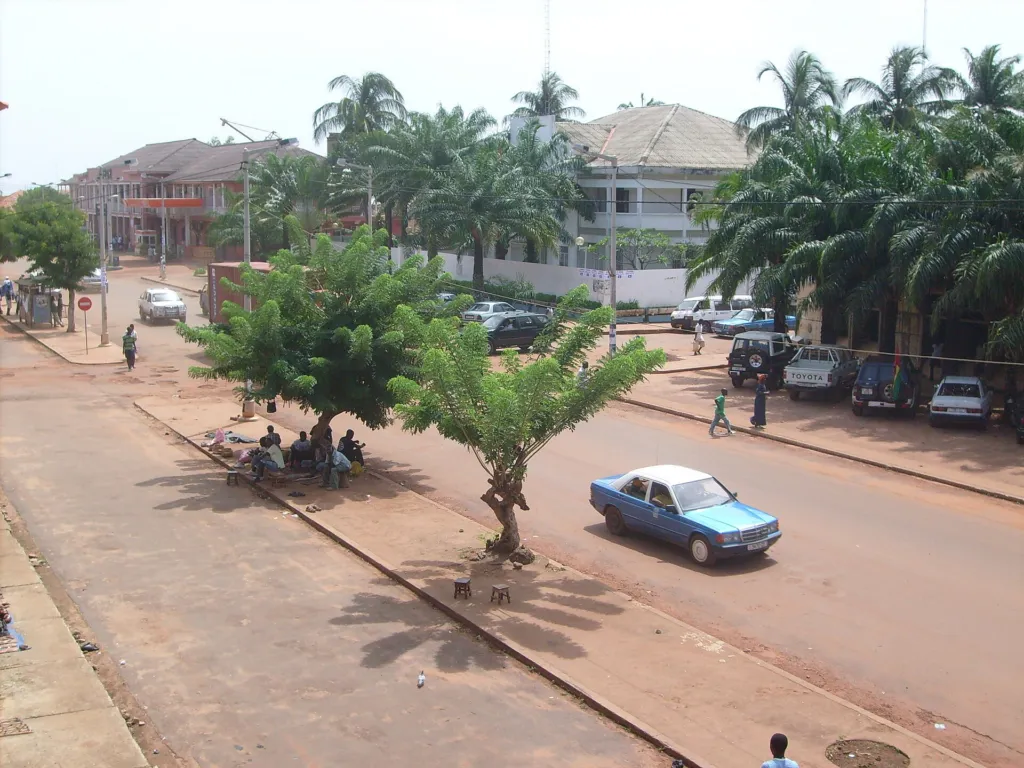
Top photo: Central Bissau, Guinea-Bissau (file photo, 2010). Photo: Nammarci, Wikimedia Commons, CC BY-SA 3.0
