
Congo’s diesel shortage leaves mobile networks and mobile money struggling
A fuel shortage that has gripped the Republic of the Congo since early September has spread from petrol stations to the country’s mobile networks. The telecoms regulator says calls, mobile internet and mobile money are being disrupted across all or part of the country because the backup generators at mast sites cannot get enough diesel.
In a statement on 27 October, the Posts and Electronic Communications Regulatory Agency (ARPCE) said “energy is indispensable to the proper functioning of telecommunications infrastructure” (translated). It warned that the disruption would continue until the energy situation improves.
Outages across the networks
According to the ARPCE statement, as reported by Les Dépêches de Brazzaville and Agence Ecofin, customers face partial or total outages, difficulty getting a connection, dropped calls and slow data. Mobile money transactions have also been hit.
The regulator’s own checks found that operators receive about nine hours of grid electricity a day on average. Batteries add roughly six more hours. For the rest of the day, mast sites depend on diesel generators, and operators have been struggling to buy fuel.
- Scale of demand. Helios Towers, which runs 550 mast sites in the country, needs about 100,000 litres of diesel a week, or roughly 400,000 litres a month, to keep its generators running.
- Knock-on effects. Rural sites rely on equipment in the big cities, so failures at central sites spread to outlying areas.
- Official response. The Prime Minister’s office has been informed of the situation, and ARPCE says it is working with the state oil company, the Société nationale des pétroles du Congo (SNPC), to improve fuel supplies.
How the fuel shortage began
The shortage began in Brazzaville in early September, with diesel running short first and then petrol. Bénin Web TV, citing Radio France Internationale (RFI), reported that an anonymous source at the Ministry of Hydrocarbons blamed a breakdown at the petrol unit of the Congolaise de raffinage (Coraf), the national refinery in Pointe-Noire, along with the high cost of imported refined fuel.
Shortages keep coming back. A 2024 International Monetary Fund (IMF) report, cited by the same outlet, said Coraf met about two-thirds of national demand for refined products and blamed recurring supply gaps on ageing plant and too little investment. In November 2024 the hydrocarbons minister, Bruno Jean Richard Itoua, addressed an earlier shortage that had caused about two months of queues, Vox Congo reported.
When the network fails, so does mobile money
Mobile money is now a basic payment tool for many Congolese households and traders, so network failures quickly turn into lost sales and stalled payments. The episode also shows how exposed African telecoms networks are to diesel. A November 2024 report by the GSMA, the mobile industry association, found that buying and transporting fuel can make up 30% to 60% of operating costs for operators in many African countries, and that power from diesel generators typically costs three to four times as much as grid electricity.
Solar as a way out
The GSMA and the World Bank have pointed to solar power with battery storage, and to hybrid systems, as ways to cut dependence on diesel. But hybrid sites do not remove the need for diesel altogether, and they depend on investment, site conditions and maintenance. Agence Ecofin noted that ARPCE’s statement does not say whether Congolese operators already use these technologies.
Will diesel deliveries resume?
- Whether SNPC and the government restore regular diesel deliveries to tower companies and operators.
- Whether Coraf’s petrol unit returns to full production, and how much the state relies on costly imports in the meantime.
- Any move by ARPCE to relax quality-of-service penalties, or to demand backup-power plans from operators.
- Announcements by Helios Towers or the operators on solar and battery upgrades at Congolese sites.
Sources: Les Dépêches de Brazzaville (ADIAC), 27 October 2026; Agence Ecofin, 28 October 2026; allAfrica, 28 October 2026; Bénin Web TV, 6 September 2026; Leral.net, 8 September 2026; Vox Congo, 19 November 2024.
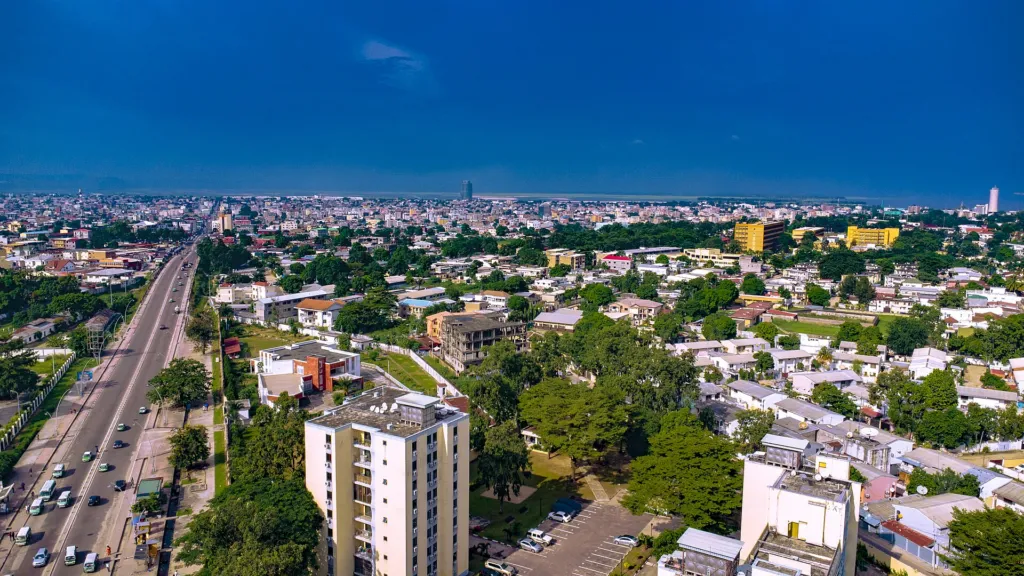
Top photo: An aerial view of Brazzaville (file photo). Photo: Prével EPOTA, Wikimedia Commons, CC BY-SA 4.0
