
Ethiopia sells power abroad while millions at home sit in the dark
Ethiopia has more electricity than ever, enough to sell hundreds of megawatts to its neighbours. Yet in many towns and villages, people still cook with firewood and study by torchlight.
The gap
According to figures cited by Ecofin Agency, about 65 percent of Ethiopians had some form of electricity access in 2025. But only 44 percent had what the World Bank classifies as “Tier 1” service or better, meaning at least a minimum level of reliable supply. That leaves about 56 percent without dependable power.
Ethiopia’s population is about 130 million, so the gap affects tens of millions of people.
Why surplus power doesn’t reach homes
Building large power plants is only part of the challenge. Getting electricity to homes requires:
- Distribution lines to reach scattered rural communities.
- Transformers and meters in every neighbourhood.
- Money to connect households, many of which cannot afford connection fees.
- Reliability, since frequent outages on old lines reduce the value of a connection.
Ethiopia also loses about 22 percent of its electricity in the network through technical faults and theft.
The Mission 300 compact
Under its National Energy Compact, prepared under the World Bank and African Development Bank’s “Mission 300” initiative to connect 300 million Africans by 2030, Ethiopia aims to:
- Expand the distribution network from about 179,000 kilometres to 456,000 kilometres by 2030.
- Raise reliable (Tier 1 or better) access to 75 percent of the population.
- Cut network losses from 22 percent to 13 percent.
- Triple annual electricity exports.
Off-grid solar systems and mini-grids are expected to serve remote areas that the grid will not reach soon.
The new national plan
On 1 November, Ethiopia’s Ministry of Water and Energy put the cost of its third National Electrification Plan (NEP 3) at more than $18 billion, Capital reported. The government is seeking nearly $11 billion of that from the World Bank and other development partners, and expects about $800 million from private investors for off-grid systems. The plan aims to raise electricity access to 75 percent within five years and reach everyone within ten, with about 4.4 million households served by off-grid solutions such as solar and the rest by the national grid.
“The private sector shouldn’t be an observer,” said Nora Kipwala, a senior energy specialist at the World Bank, according to Capital.
The trade-off
Exports bring in hard currency that can help fund grid expansion. Critics argue that domestic connections should come first. The government says the two goals support each other, as export earnings help make the state utility, Ethiopian Electric Power, financially viable.
Conflict in parts of the country, including Amhara and Oromia, also makes it harder to build and maintain infrastructure.
Connections, losses and the home grid
- Progress on new distribution lines and household connections.
- Network losses, a sign of whether the grid is improving.
- Financing from the World Bank and other partners under Mission 300.
Sources: Capital, 1 November 2026; Ecofin Agency, 17 September 2026; Ethiopian News Agency; World Bank Mission 300; Prospect.
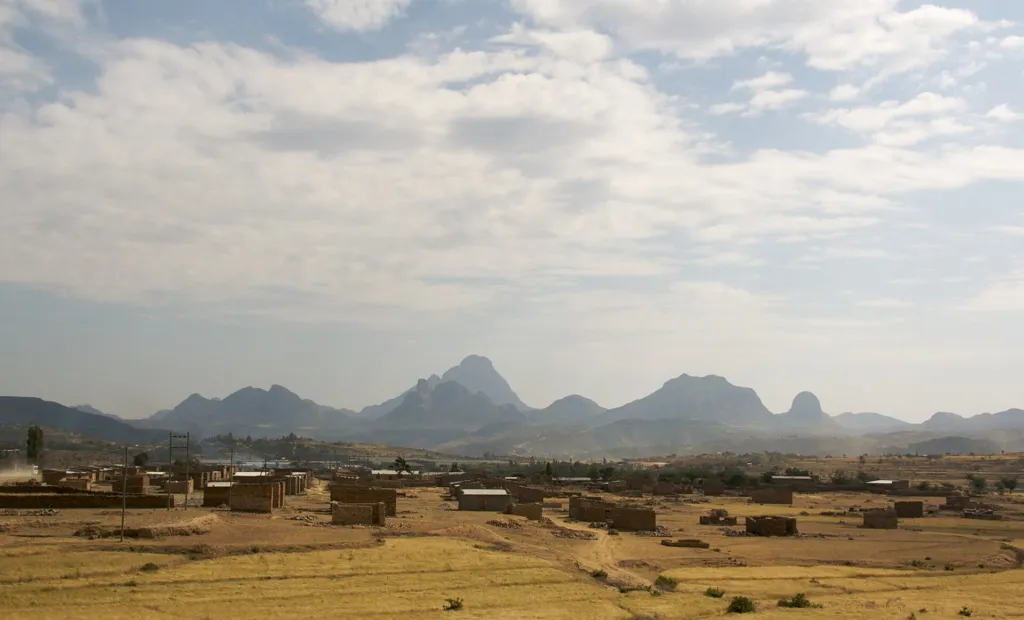
Top photo: A village in northern Ethiopia (file photo). Photo: A. Davey, Wikimedia Commons, CC BY 2.0
