
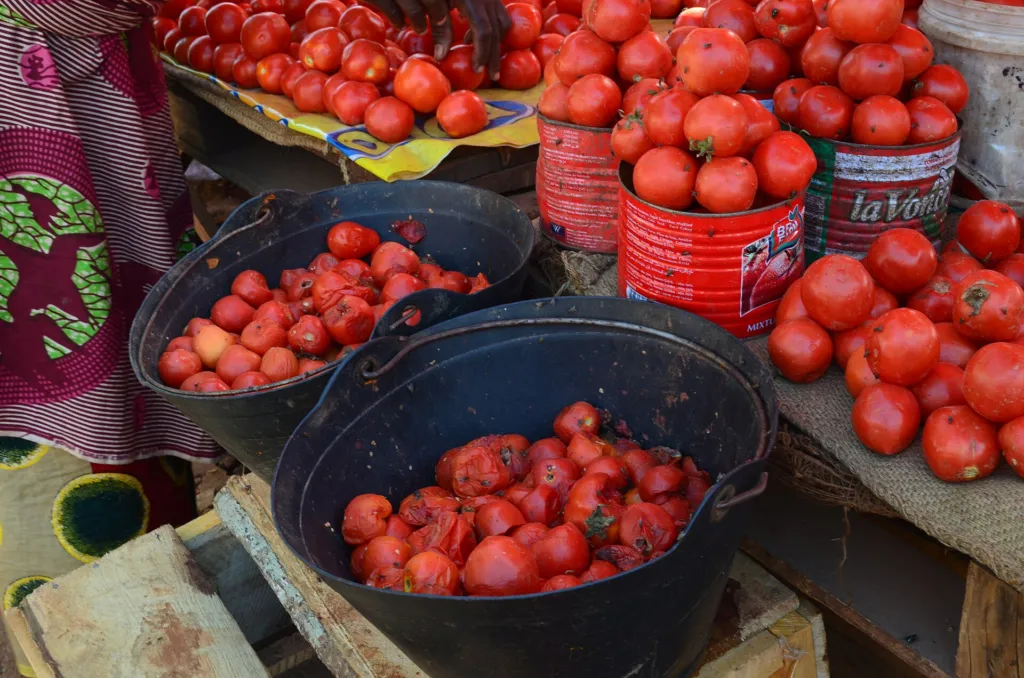
Tomatoes are 119% dearer than last year, yet readers say there is a glut. Both are true
Our story on Monday reported that tomatoes in Ghana cost 119 percent more than a year ago. Several readers in Accra and Kumasi wrote back to say the opposite: tomatoes are cheap, and there is a glut.
“We went to Agbogbloshie last month to buy tomatoes. It was so cheap. It was in glut. So how did prices rise so fast in less than a month?” asked Kwaku Duah, an Accra businessman.
In Kumasi, Baah Acheamfour wrote: “As a matter of fact, there is a tomato glut as I speak. Very cheap.”
The short answer is that both things are true.
What does the 119 percent measure?
The figure comes from the Ghana Statistical Service. It compares tomato prices in October 2026 with October 2025, a year apart. It does not say prices rose 119 percent in one month. Our headline did not make that clear, and we have changed it.
Why are tomatoes so cheap right now?
Prices have fallen fast since the local harvest began.
- A bad first half of the year. In February, an attack on Ghanaian tomato traders in Burkina Faso killed at least eight people, MyJoyOnline reported, and Kumasi’s RaceCourse Market went without tomato trucks. Prices then climbed to record levels. In September, one trader told The Herald that a basket that sold for about GH¢200 a year earlier cost as much as GH¢700.
- Then the harvest. “The prices of tomatoes should see a sharp decline in the coming weeks as Ghanaian farmers have started harvesting,” Deputy Agriculture Minister John Dumelo wrote on 7 September.
- Now a glut. In the Upper East’s Nabdam district, a bucket of tomatoes fell from GH¢120 to GH¢150 in early September to GH¢60 to GH¢70 in early October, Graphic Online found.
So October was far cheaper than the summer, but still dearer than October 2025, when prices were lower to begin with.
Who loses in a glut?
Farmers. “Now we are not even breaking even with the current prices,” Samson Wougnab, a tomato and pepper farmer, told Graphic Online. Food vendor Ateni Ababila said that buying in Pelungu and selling in Bolgatanga often leaves little or no profit.
Some readers blamed market traders for keeping city prices higher than farm prices. We have not yet found a traders’ response to those claims this year. In a GhanaWeb report from October 2025, a seller at Accra’s markets said that “customers keep saying there’s plenty in supply, yet the quantity in each box has reduced”. We will add the traders’ side if their representatives respond.
What comes next
Gluts do not last. A food vendor at Pelungu market, Yenmah Mba, told Graphic Online she expects prices to rise again by December. A government dry-season farming programme is planned from December to June. November’s inflation figures are due in early December.
Sources: Readers’ messages, 9 November 2026, quoted with permission; Graphic Online, 4 November 2026; Graphic Online, 10 October 2026; The Herald Ghana, 8 September 2026; MyJoyOnline, 27 February 2026; GhanaWeb, 4 October 2025.
Top photo: Tomatoes for sale in a market in Tamale, Ghana (file photo, 2015). Photo: Ibn Shiraz, Wikimedia Commons, CC BY-SA 4.0
