
Blockades, bombings, a dead minister: is Mali’s junta losing control?
When Mali’s soldiers seized power in 2020 and again in 2021, they promised to restore security. Five years on, the military government of General Assimi Goïta is facing its most serious challenge yet from the al-Qaeda-linked group Jama’at Nusrat al-Islam wal-Muslimin (JNIM).
The fuel blockade
In September 2025, JNIM announced a blockade of fuel imports into Mali, attacking tanker convoys on the main routes from Senegal and Côte d’Ivoire. Dozens of trucks were burned in single attacks.
The effects in the capital, Bamako, were severe. Long fuel queues formed, businesses closed, power cuts spread and schools across the country shut for about two weeks from late October. The United States and the United Kingdom urged their citizens to leave. Convoys escorted by the army and Russian paramilitaries eventually brought fuel through, and Russia pledged petroleum supplies.
The blockade eased in early 2026, but attacks on convoys never stopped. In mid-September, JNIM struck two military-escorted fuel convoys heading from Senegal towards Bamako, one of them only about 100 kilometres from the capital, burning around 20 trucks.
The April offensive
On the weekend of 25 and 26 April, JNIM fighters and the Tuareg separatist Azawad Liberation Front (FLA) launched coordinated attacks on the army and its Russian allies. The northern town of Kidal, which the army had recaptured with great fanfare in 2023, fell back into rebel hands.
Most strikingly, Defence Minister Sadio Camara was killed by a car bomb at his residence. At least 23 people died in the attacks, including civilians and children, according to reports citing UNICEF. Goïta took over the defence ministry himself. JNIM then announced a blockade of Bamako, which has been only partially effective.
Dioura
On 10 September, JNIM stormed an army camp at Dioura in central Mali. Security sources told AFP that at least 50 Malian soldiers and five Russian paramilitaries from the Africa Corps were killed. Some sources put the toll higher, with dozens taken prisoner. The army said it responded with air and ground strikes.
Why Mali is struggling
- Vast territory. Mali is twice the size of France, with long, porous borders.
- Fewer allies. The junta expelled French forces, ended the UN peacekeeping mission and left the regional bloc ECOWAS, relying instead on Russian paramilitaries and its Sahel allies, Burkina Faso and Niger.
- Local grievances. JNIM exploits poverty, ethnic tensions and abuses by security forces to recruit.
- Economic strangulation. By targeting fuel, JNIM hits the whole economy rather than only the army.
Diplomacy shifting
Mali’s relations with its neighbour Algeria, long tense, appear to be thawing. Algeria’s prime minister visited Bamako in September, and preparations are under way for a visit by Goïta to Algiers.
The human cost
Civilians bear the brunt. Fuel shortages drive up the price of food and transport, schools close, and communities are caught between jihadist fighters and military operations that rights groups say have also killed civilians.
Fuel convoys and talks
- Fuel supplies to Bamako and whether convoys can get through.
- Any negotiations, formal or informal, between the authorities and JNIM.
- The role of Russia’s Africa Corps after its losses.
- Stability within the junta itself after the death of a key figure.
Sources: Africanews, 4 May 2026; The Sahel Brief, 15 September 2026 (citing AFP and RFI); Wikipedia, Mali fuel blockade.
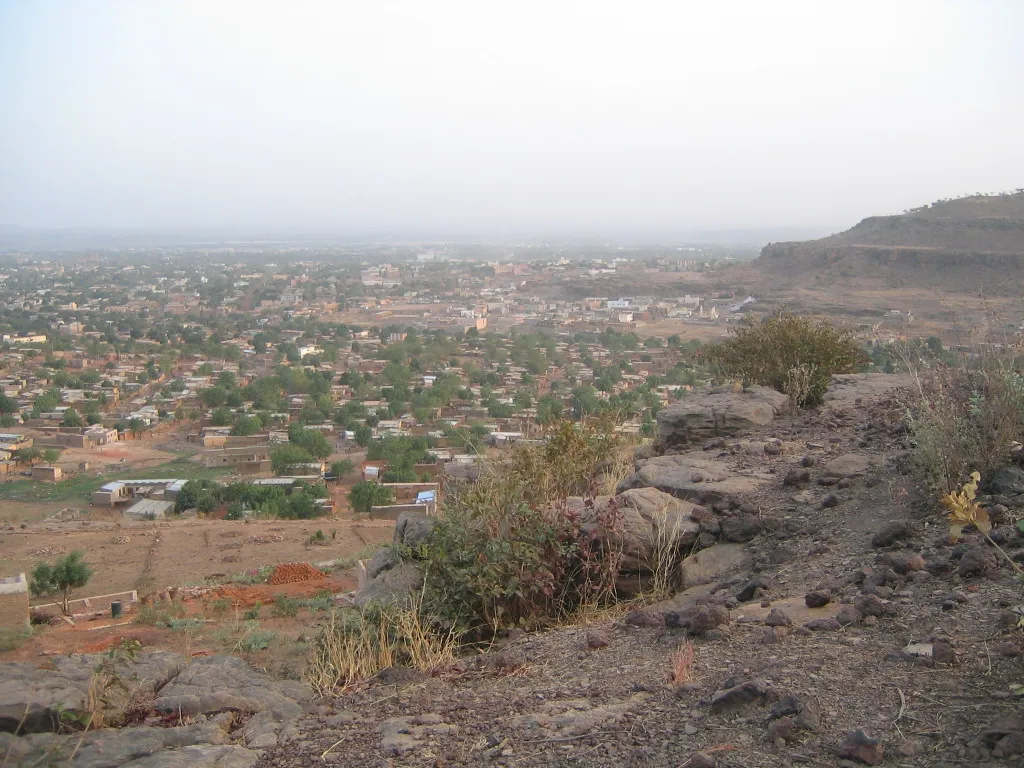
Top photo: A hilltop view over Bamako, Mali’s capital (file photo). Photo: Guaka, Wikimedia Commons, CC BY-SA 3.0
