South Africa’s 4 November local elections in numbers
South Africans vote on 4 November to elect the councils that run their cities, towns and rural municipalities. It is the first nationwide vote since the 2024 general election ended the African National Congress’s (ANC) outright majority and produced a coalition Government of National Unity, and it will test the parties’ strength where it matters most to voters: water, electricity, roads and refuse collection.
The election in numbers
According to the Electoral Commission of South Africa (IEC):
- 136,790 candidates are standing, which the IEC calls unprecedented. In 2021 there were 95,427.
- 98,219 are party candidates for ward seats, 38,571 are on party proportional representation (PR) lists, and 621 are independents.
- 10,526 seats are up for election, up from 10,478 in 2021.
- Voting takes place in 8 metropolitan municipalities, 44 district municipalities and 205 local municipalities.
- 5,096 candidates were disqualified after checks, for reasons including unpaid deposits and incomplete paperwork.
- 84 percent of nominations were submitted online.
Very long ballots
Some of the biggest cities will have exceptionally crowded PR ballots. Johannesburg has 75 parties on its list, Tshwane 70, eThekwini (Durban) 69, Ekurhuleni 67 and Cape Town 55. These metros will use double-column ballot papers, and voters may need extra time in the booth.
The ANC’s ballot scare
The ANC came close to missing the ballot in six municipalities in the Eastern Cape, KwaZulu-Natal and the Mangaung metro. The IEC excluded 181 of its candidates because the party had not finalised its lists on the IEC’s online system before the 28 August deadline, and the Electoral Court backed the IEC on 16 September.
On 15 October the Constitutional Court overturned that decision and ordered the IEC to “do all things necessary” to put the 181 candidates on the ballot papers for 4 November. The ANC had argued that it was not adding new candidates, only people whose details were already on the IEC’s system at the cut-off. Two of the court’s justices dissented, and the court will publish its full reasons later.
Why local elections matter
Municipalities deliver the services South Africans use every day, and many are in serious trouble. Years of mismanagement, unpaid bills and failing infrastructure have left some councils unable to provide reliable water or keep roads repaired.
Coalition politics has also reshaped local government. Since 2016, several big metros, including Johannesburg and Tshwane, have been run by unstable coalitions, with frequent changes of mayor. Many voters and business groups argue that these shifting alliances have made city government harder to manage.
What to watch
- The ANC’s share of the vote, after it fell to about 40 percent nationally in 2024.
- The Democratic Alliance, its main partner in the national coalition, and whether it can expand beyond its Western Cape base.
- The MK Party and the Economic Freedom Fighters, especially in KwaZulu-Natal and Gauteng.
- Small parties and independents, who could become kingmakers in hung councils.
- Turnout, which has been falling in recent local elections.
Key dates
- 2 and 3 November: special votes for people who cannot reach a voting station, including the elderly and those with disabilities.
- 4 November: election day.
Correction, 29 October 2026: an earlier version of this story said the ANC would be missing from the ballot in six Eastern Cape municipalities. On 15 October the Constitutional Court ordered that its 181 candidates be restored; the municipalities are in the Eastern Cape, KwaZulu-Natal and Mangaung.
Sources: Electoral Commission of South Africa via SAnews, 16 September 2026; Daily Maverick, 16 September 2026; Eyewitness News, 15 October 2026.
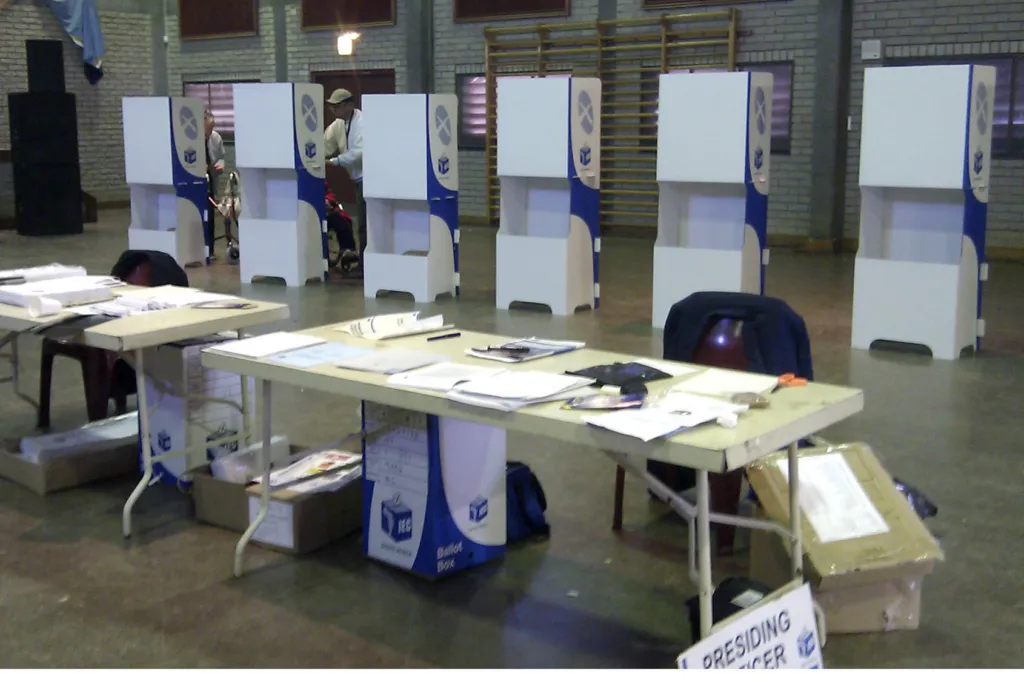
Top photo: A voting station run by the Electoral Commission of South Africa during the 2011 local elections (file photo). Photo: warrenski, Wikimedia Commons, CC BY-SA 2.0
