
After a hidden-debt scandal, Senegal lands a $2.2 billion IMF lifeline
Senegal has reached a staff-level agreement with the International Monetary Fund on a new $2.2 billion, 36-month programme, a crucial step for a country still recovering from one of the most damaging debt revelations in recent African history.
The deal, announced on 1 September, still needs approval from the IMF’s executive board, and more than two months on, no board date has been set. On the same day, Senegal asked its foreign creditors for a “debt treatment”, opening a delicate negotiation that will now decide when the money arrives.
How Senegal got here
In 2023, the IMF agreed a $1.8 billion programme with Senegal. Then politics changed everything.
After opposition candidate Bassirou Diomaye Faye won the 2024 presidential election, his new government accused the previous administration of President Macky Sall, who governed from 2012 to 2024, of concealing the true state of the public finances. An audit and the IMF’s own review confirmed large discrepancies:
- The 2023 budget deficit was 12.3 percent of GDP, not the 4.9 percent previously reported.
- Public debt reached about 132 percent of GDP at the end of 2024, one of the highest levels in sub-Saharan Africa.
The IMF suspended the old programme in 2024. Because the misreporting broke the terms of earlier IMF lending, Senegal has had to take what the Fund calls “decisive corrective measures” to support its request for a waiver.
Painful progress
The government has cut spending sharply. According to the IMF, the fiscal deficit fell from 13.4 percent of GDP in 2024 to 6.4 percent in 2025.
But the cost of borrowing has stayed high. Without IMF support, Senegal has relied mainly on the regional bond market of the West African Economic and Monetary Union, which is more expensive than loans from international lenders or development banks. Moody’s downgraded Senegal’s rating further into junk territory during the negotiations, to Caa2.
A new IMF programme should help Senegal unlock cheaper financing from other lenders and reassure investors.
The debt question
Senegal’s finance ministry wants to treat about $5 billion of Eurobonds and other foreign-currency commercial debt, and has asked the G20 to use its Common Framework, the mechanism set up for countries that need debt relief. Debt raised on the regional CFA franc market is excluded. Finance Minister Cheikh Diba calls it “a specific treatment rather than a classic restructuring”, but markets see it differently: bondholders formed a negotiating group in September, and S&P rates Senegal CC, saying a distressed exchange is “extremely likely”.
The IMF says that before its board can approve the programme, it needs financing assurances from Senegal’s official creditors on that treatment, not a final deal with every lender. “This is only about financing guarantees. It is not about treatment agreements with creditors,” Zeine Ould Zeidane, director of the IMF’s African Department, said in mid-October.
A split at the top
The deal comes amid a political rift. Faye and his former prime minister, Ousmane Sonko, rose to power together on a promise of sovereignty and reform. Earlier this year they fell out, partly over the approach to the IMF.
Faye dismissed Sonko as prime minister in May and appointed Ahmadou Al Aminou Lô in his place. Sonko was then elected speaker of the National Assembly, a powerful position from which he could make it harder for the president to pass reforms linked to the IMF deal.
The two men differ on strategy. Faye favours a more conciliatory approach with the Fund. Sonko has long rejected any restructuring of Senegal’s debt, which makes the label on the new plan politically sensitive.
What it means for ordinary Senegalese
IMF programmes usually come with conditions: higher taxes, lower subsidies, tighter spending. For households already facing high living costs, that can be painful. Supporters argue that restoring credibility is the only way to bring down borrowing costs and protect spending on health and education in the long run.
Senegal is also counting on new oil and gas revenues, after production began at offshore fields in 2024, to ease the pressure over time.
Board approval and creditor talks
- IMF board approval, which depends on assurances from official creditors, and the first disbursement.
- Creditor talks. How much Eurobond holders are asked to give up, and whether Senegal keeps paying them while talks go on.
- Parliament. How the National Assembly, under Sonko, handles budget reforms.
- Investor confidence, reflected in Senegal’s bond yields and credit ratings.
Sources: Africanews/AFP, 1 September 2026; IMF, 1 September 2026; Rio Times, 14 September 2026; Financial Afrik, 17 October 2026; Moody’s; S&P.
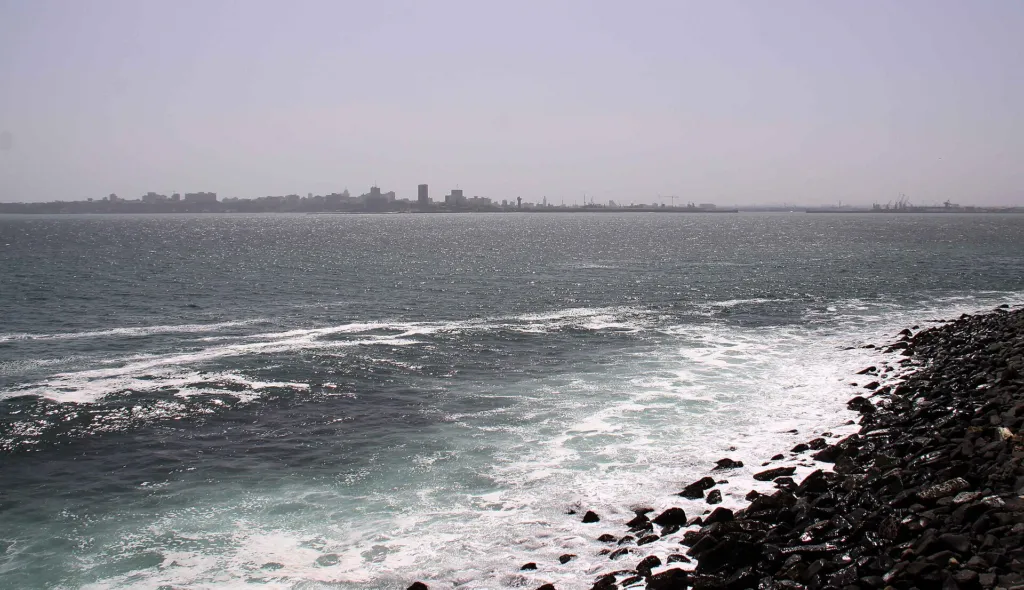
Top photo: The Dakar skyline seen from Gorée Island (file photo). Photo: Vincenzo Fotoguru Iaconianni, Wikimedia Commons, CC BY-SA 2.5
