
Your 91-day T-bill now pays less than inflation. Here’s what that means for your money
For the past few years, Ghanaian savers had an easy answer to the question of where to keep spare cash: the 91-day Treasury bill. It paid well, it was backed by the government, and it was short enough to roll over every quarter. That answer no longer works the way it did.
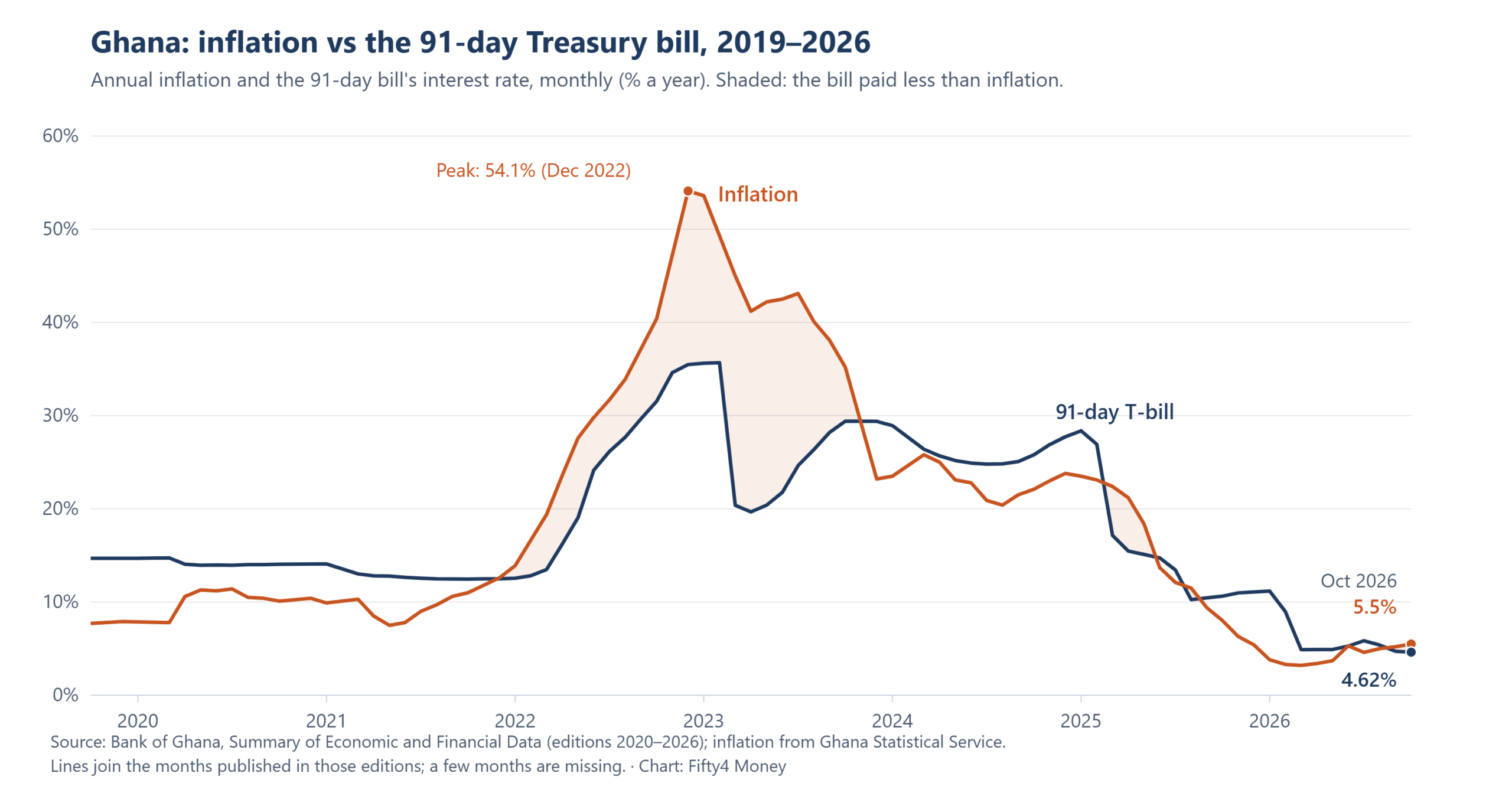
At the auction issued on 23 November, the 91-day bill paid 4.52% a year. Inflation in October was 5.5%. Since September, Ghana’s most popular savings product has been paying less than the rate at which prices are rising.
In 30 seconds
- The 91-day bill paid 4.52% at the 23 November auction. October inflation was 5.5%.
- That is a real return of about −0.9%: GH¢10,000 in 91-day bills for a year falls about GH¢98 short of rising prices.
- The 364-day bill (9.45%) and bank time deposits still pay more than inflation, but tie your money up for longer.
- Bonds pay more again, but their prices move with interest rates and they carry restructuring risk.
The numbers
- Inflation: 5.5% in October 2026, up from 5.2% in September, according to the Ghana Statistical Service.
- 91-day T-bill: 4.52% (auction issued 23 November). A year ago it paid more than 10%.
- 182-day T-bill: 6.12%.
- 364-day T-bill: 9.45%.
- Bank of Ghana policy rate: 11%, after a cut of 3 percentage points on 18 November.
A Treasury bill is a short-term loan to the government. You pay now and get your money back with interest when the bill matures, after 91, 182 or 364 days. The rates above are annual rates.
What “real return” means
The interest rate on a savings product is its nominal return. What matters for your buying power is the real return: the interest left after inflation.
A simple way to work it out is: (1 + interest rate) ÷ (1 + inflation rate) − 1. Using the latest figures:
- 91-day bill: about −0.9% a year. Savers are losing buying power.
- 182-day bill: about +0.6%. Roughly breaking even.
- 364-day bill: about +3.7%. Still ahead of prices.
An illustration: GH¢10,000 kept in 91-day bills for a year at 4.52% would earn about GH¢452, if the rate stayed the same at each rollover. But goods that cost GH¢10,000 a year earlier would cost about GH¢10,550 at 5.5% inflation. The saver would be about GH¢98 short. The same amount in a 364-day bill at 9.45% would earn about GH¢945, leaving the saver about GH¢395 ahead.
These are rough figures. They compare today’s interest rates with inflation over the past twelve months, and nobody knows what inflation will be over the next twelve. Interest rates at the next rollover may also be different.
How Ghana got here
The low rates are the result of good news. Inflation fell sharply through 2025 and 2026, and the Bank of Ghana cut its policy rate step by step, from 25% at the end of July 2025 to 11% today.
At its September briefing, Governor Johnson Pandit Asiama said: “Presently, headline inflation remains below the lower bound of the medium-term target band.”
Inflation has since edged up. At the November briefing, he said: “The increase in non-food inflation was attributed mainly to higher utility tariffs and crude oil prices.” The bank also listed crude oil prices, possible El Niño effects on food production and utility tariff changes as risks it is watching.
Demand at the weekly auctions has also cooled. Several recent auctions raised less than the government’s target, and the Treasury has rejected some of the bids it received.
What savers are weighing
Each option below has trade-offs. None is right for everyone, and none is a recommendation.
- Longer Treasury bills. The 364-day bill still pays well above inflation. The cost is that your money is tied up for a year, and the rate when you roll over may be lower.
- Bank time deposits. Bank of Ghana data for October showed three-month time deposits averaging 9.72% and six-month deposits 10.28%. Ordinary savings accounts averaged 4.00% and demand deposits 3.62%, both below inflation. Rates differ widely between banks, and early withdrawal can cost you interest.
- Government bonds. Bonds issued in the 2023 domestic debt exchange were trading at yields of about 13.9% to 14.9% in mid-October, according to Business Post. Bond prices can fall as well as rise before maturity, they are harder to sell quickly than bills, and the 2023 exchange cut returns for many existing holders.
- Money market and mutual funds. These pool savers’ money, often into bills and deposits, so their returns tend to follow those rates down. Returns are not guaranteed.
- Shares. Listed companies can pay dividends and rise in value over time, but prices can also fall sharply, and many Ghanaian stocks trade rarely, which can make them hard to sell.
- Dollars and forex trading. Some savers keep part of their money in US dollars, for example in a bank foreign-currency account, to protect against a weaker cedi. By 13 November the cedi had lost 10.6% against the dollar this year, Bank of Ghana data show. But dollar savings earn little interest, and the cedi can strengthen as well as weaken. Forex trading is different: it means betting on currency moves, often on online platforms that let you trade with borrowed money. That can multiply gains, but losses can be just as fast and large, and you can lose all you put in. It is speculation, not saving. Check that any platform or broker is licensed by the SEC before sending money. The SEC keeps a list of entities operating without a licence and has warned the public about schemes that promise high returns in a short time.
Big investors are already moving. Trading on the Ghana Fixed Income Market reached GH¢337.79 billion in the first nine months of 2026, up 85.6% on a year earlier, with the debt-exchange bonds making up an estimated half or more of daily trading, Business Post reported.
A closer look: the bond trade-off
The debt-exchange bonds stand out because of the gap. In mid-October, a bond due in February 2030 was trading at a yield of about 14.2%, according to Business Post. That is nearly 5 percentage points more than the 364-day bill, and nearly 9 points above inflation.
That extra return is not free. It is what the market charges for risks a short bill does not carry. The scenarios below are an illustration only, using GH¢10,000 and rounded figures. They are not a forecast or a recommendation.
- Hold to maturity, and the government pays as promised: about GH¢1,420 a year in return, against about GH¢945 from a 364-day bill.
- Market rates fall by 2 points and you sell: as a rough guide, the price of a bond with about three years left moves around 2.5% for every 1-point change in market rates, in the opposite direction. A 2-point fall could add around GH¢500 to the bond’s value, on top of the interest.
- Market rates rise by 2 points and you need to sell: the same rule works the other way. The price could drop by around GH¢500, wiping out about a third of a year’s interest. Holding on until 2030 avoids that loss, but only if you can leave the money there.
- Another debt restructuring: this is the big one. In the 2023 exchange, bondholders were given new bonds with lower interest and later repayment dates. The government is now setting aside 7% of non-oil tax revenue each month in a sinking fund to repay about GH¢111 billion due in 2027 and 2028, Business Post reported. That is meant to reassure investors, but it is not a guarantee.
Costs matter too. Individuals buy through a bank or a licensed broker, and the price you can buy or sell at may be less favourable than the headline yield, especially for small amounts. Ask for the exact bond, its maturity date, its interest payments, and the buying and selling prices including all fees before committing.
The short version: a higher yield means taking on more risk, for longer. Whether that trade suits anyone depends on when they will need the money and how much of their savings it would be.
Before you move your money
- Keep an emergency fund you can reach quickly, even if it earns little.
- Match the term to your needs. Money you will need in three months should not be in a product that locks it up for a year.
- Don’t put everything in one place.
- Check licences. Banks are licensed by the Bank of Ghana. Brokers, fund managers and investment advisers must be licensed by the Securities and Exchange Commission (SEC).
- Look at the fees and any tax on what you earn.
What to watch
The Ghana Statistical Service publishes November’s inflation figure in early December. Treasury bill auctions are held every week, and their results show which way short-term rates are moving. If inflation keeps rising while bill rates stay low, the gap facing savers in short-term bills will widen.
Related on Fifty4 News
- Bank of Ghana cuts its key rate to 11%, a multi-decade low. What changes for loans and savings?
- Tomatoes up 119% on a year ago, transport up 8% in a month: the prices behind Ghana’s budget on Thursday
- Inflation is creeping back up in many of Africa’s big economies
- Fifty4 Money Ghana: today’s fuel prices, cedi rates and T-bills
For information only, not investment advice. Speak to an SEC-licensed investment adviser or broker before investing.
Sources: Ghana Statistical Service – inflation, Bank of Ghana – policy rate trends, Bank of Ghana – MPC press release, November 2026, Bank of Ghana – Summary of Economic and Financial Data, November 2026, SEC Ghana – investment scam alert, Graphic Online – BoG realigns policy rate to 11% amid inflation risks, Accra Street Journal – T-bill auction, 23 November 2026, GhanaWeb – 91-day T-bill yields fall below inflation, GhanaWeb/Business Post – Investors turn to DDEP bonds as T-bill yields fall
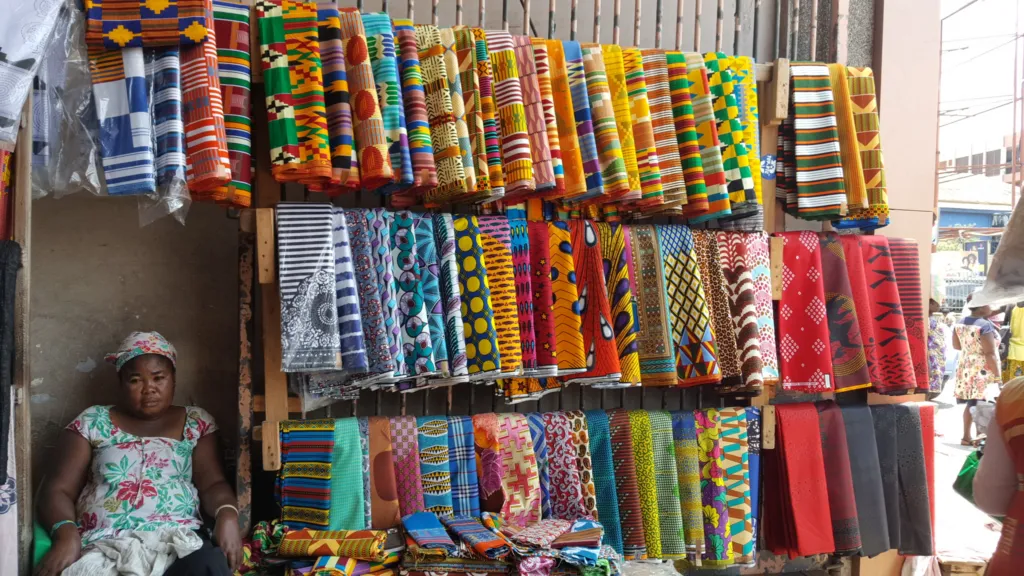
Top photo: A trader at Makola Market in Accra (file photo). Photo: Vrinda Khushu, Wikimedia Commons, CC BY-SA 4.0
