
Biya is 93 and spent 73 days abroad this year. Who rules Cameroon next?
When Paul Biya returned to Yaoundé on 20 August after 73 days abroad, it was the longest absence of any Cameroonian head of state in the country’s history. The trip, officially described as a short private stay in Europe, has sharpened a question many Cameroonians have asked for years: what happens after Biya?
The absence
Biya left Cameroon on 7 June. The government described the journey as a “short private stay in Europe”. The magazine Jeune Afrique reported that it had a medical dimension, and that the president was treated at a private clinic in Geneva after feeling unwell during the 20 May national day celebrations. The government did not confirm this.
As weeks passed without a public appearance, rumours spread. On 2 August, Communication Minister René Emmanuel Sadi said the president was alive and had not resigned. Throughout the absence, Biya continued to govern by decree, signing appointments, a military reshuffle and financing agreements with the Islamic Development Bank.
His return was timed to welcome the national women’s football team, the Indomitable Lionesses, who won the Women’s Africa Cup of Nations in Morocco on 16 August.
Since his return
The questions did not go away. On 15 October, a claim on X that Biya had died spread quickly online. Samuel Mvondo Ayolo, director of the Civil Cabinet at the presidency, told Jeune Afrique the report was false. “Can you hide the death of a head of state?” he asked, pointing to a decree the president had signed that day as proof that he was still at work. Opposition lawmaker Jean Michel Nintcheu has asked the country’s constitutional court to declare the presidency vacant.
Four decades in power
Biya, now 93, has led Cameroon since 1982, making him one of the world’s longest-serving heads of state. He won an eighth term in the October 2025 election, which will keep him in office until 2032 if he serves it in full. Opposition candidate Issa Tchiroma Bakary claimed victory before official results were announced, and the vote was followed by protests and arrests.
The succession question
For years, Cameroon’s constitution has provided for the president of the Senate to act as interim head of state if the presidency becomes vacant, pending a new election. In April, the country created the post of vice-president, a change many saw as a step towards organising a clearer succession. That post, restored by a constitutional amendment promulgated on 14 April, remains vacant, and the law sets no deadline for filling it. In June, a sealed envelope containing a purported decree naming a vice-president was delivered to the state broadcaster CRTV; the government said it had not been issued through the proper process, and the person who delivered it was detained. Meanwhile, the new government Biya promised “in the coming days” in his 31 December address had still not been named by mid-October.
Government spokesman René Emmanuel Sadi told RFI in August that it was “quite normal for him to take his time when entrusting such a high office to one of his fellow citizens”. Opposition leader Cabral Libii sees it differently. “Appointing your vice president means securing your leadership,” he told Al Jazeera. In Yaoundé, 39-year-old Elvis Mbi summed up the mood: “No one knows anything any more.”
Analysts say the uncertainty carries real risks:
- Political. Rival factions within the ruling Cameroon People’s Democratic Movement may compete for influence.
- Security. Cameroon faces a separatist conflict in its English-speaking North-West and South-West regions, and attacks by Boko Haram-linked groups in the Far North.
- Economic. Investors and lenders look for stability and clear decision-making. Jason Healy of BMI, a Fitch Solutions company, has warned that prolonged uncertainty could deter investors.
What to watch
- Whether Biya appoints a vice-president, and who.
- The naming of the post-election government.
- Public appearances by the president, which have become rarer.
- Developments in the Anglophone crisis, which has killed thousands since 2017 and remains unresolved.
For a country where most citizens have known only one president, the coming years are likely to bring the biggest political transition in more than four decades.
Sources: RFI and Jeune Afrique via AllAfrica, 19 August 2026; Al Jazeera, 17 October 2026; Jeune Afrique via Sahara Reporters, 16 October 2026; AP.
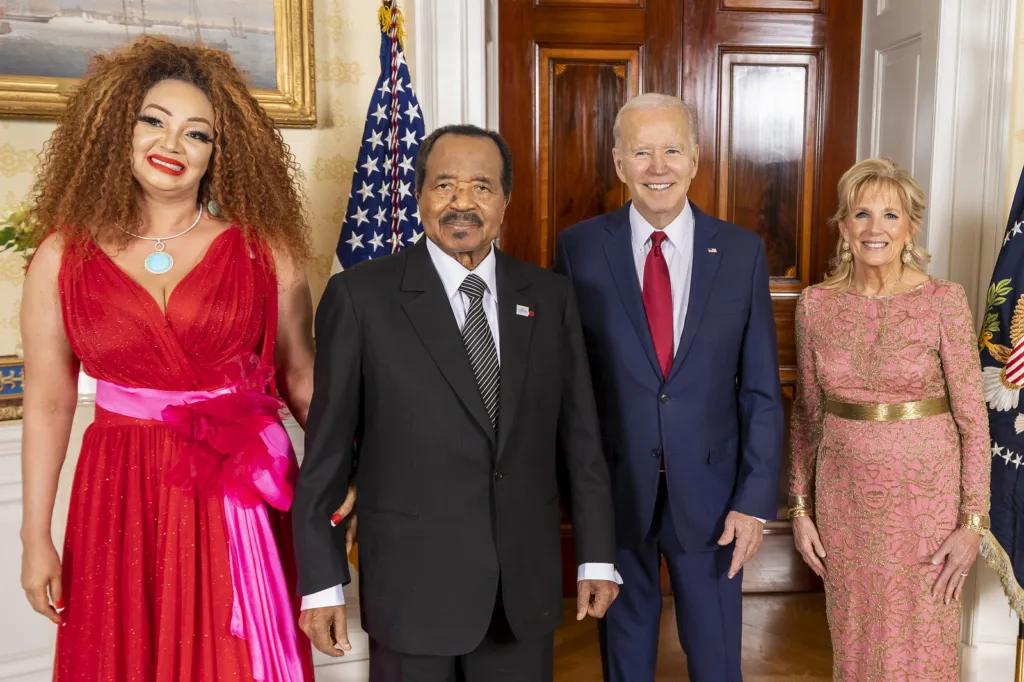
Top photo: Paul Biya and his wife Chantal Biya with Joe and Jill Biden at the White House during the US-Africa Leaders Summit, December 2022 (file photo). Photo: Adam Schultz, Official White House Photo, Wikimedia Commons, public domain
