
Hichilema’s last term starts under a cloud. Here’s what Zambians want
Hakainde Hichilema was sworn in for his second and final term as Zambia’s president on 1 September at National Heroes Stadium in Lusaka, in front of thousands of supporters and a row of regional leaders, including Kenya’s William Ruto, Namibia’s Netumbo Nandi-Ndaitwah, Botswana’s Duma Boko, Zimbabwe’s Emmerson Mnangagwa and Tanzania’s Samia Suluhu Hassan.
The result
In the 13 August election, Hichilema won about 61 percent of the valid vote, according to the Electoral Commission of Zambia. His main challenger, Brian Mundubile, took about 38 percent in his first run for the presidency. Some five million votes were cast.
It was Hichilema’s seventh attempt at the presidency in his political career. He first won in 2021, defeating the incumbent, Edgar Lungu.
No petition was filed with the Constitutional Court within the seven-day window, clearing the way for the inauguration. Human Rights Watch says the courts were closed about two weeks after the vote, preventing legal challenges; police described the closure as an “intelligence-led and preventive measure”.
A tense night
Election night was not entirely calm. Authorities arrested 11 people, including opposition figures, in a raid that involved gunfire. The government said the operation targeted “militia activity”. Mundubile’s party said the raid took place at his home. Human Rights Watch later reported that former cabinet minister Mutotwe Kafwaya was shot and killed during the operation.
The electoral commission also suspended counting for several hours after reports of violence against polling staff and the theft of ballot papers. Mundubile called for an independent investigation into possible changes to result forms, a claim Hichilema’s camp rejected.
What observers said
The European Union’s observer mission said voting itself was largely peaceful but that the wider process took place in an environment that limited fundamental freedoms. Its chief observer, Michael McNamara, said “late legal changes, legal uncertainty, and unequal campaign conditions distorted the playing field.”
Concerns have grown since the inauguration. In a report published on 1 November, Human Rights Watch said police and soldiers had “forcibly disappeared, arbitrarily detained, beat, and threatened” opposition members, supporters, lawyers and journalists. Mundubile was in detention, accused of treason, when Hichilema was sworn in, and about a dozen other opposition figures who questioned the results have been arrested, the group said. Al Jazeera’s report carried no response from the government.
Even so, Zambia’s democratic record remains one of the strongest in the region. Every change of president since the return of multiparty politics in 1991 has come through the ballot box.
The economy is the priority
Zambians have high expectations. Hichilema came to power in 2021 promising to fix an economy weighed down by debt, after Zambia became the first African country to default on its debts during the Covid-19 pandemic. His government has since agreed restructuring deals with official and private creditors.
Copper is central to the country’s plans. Zambia is Africa’s second-largest copper producer, and the government wants to raise output sharply as global demand for the metal grows with electric vehicles and power grids.
But many households are still struggling. A severe drought in 2024 cut harvests and hydroelectric output, causing long power cuts that hurt businesses and families. Annual inflation rose to 6.3% in October from 6.1% in September, driven by non-food prices such as housing, utilities and transport, according to the Zambia Statistics Agency.
What to watch
- Jobs and living costs, the issues most voters cite.
- The copper expansion, and whether more of the mining wealth reaches ordinary Zambians.
- Civil liberties, after observers and Human Rights Watch raised concerns about the campaign and its aftermath.
- Succession. As this is his final term under the constitution, the race to succeed Hichilema in 2031 will begin sooner than many expect.
Sources: Al Jazeera, 18 August 2026; Sunday World, 2 September 2026; EU Election Observation Mission statement; Zambia Statistics Agency, 29 October 2026; Al Jazeera, 2 November 2026.
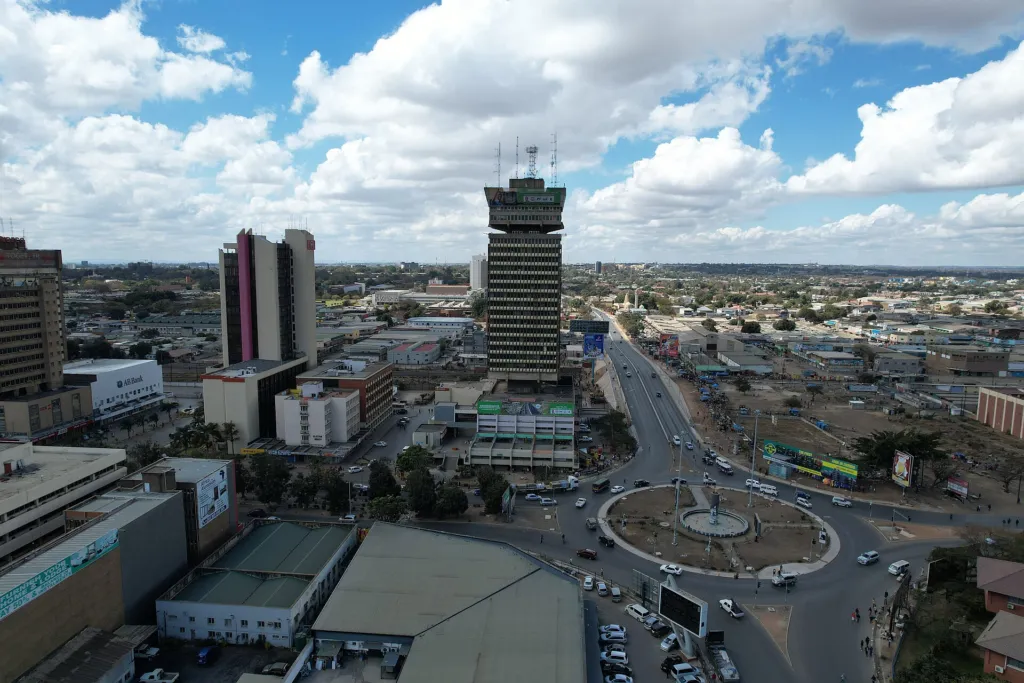
Top photo: Lusaka’s central business district (file photo, 2021). Photo: Lupali, Wikimedia Commons, CC BY-SA 4.0
