ANC sinks to 30% as hung councils double: what South Africa’s local vote changed
South Africa’s governing African National Congress (ANC) has recorded its worst result since the end of apartheid. Final results declared by the Electoral Commission of South Africa (IEC) on 8 November gave the party 30.76 percent of the vote in the 4 November local elections, down almost 15 points from 45.59 percent in 2021. It is still the largest party, but most councils now have no majority, and coalition talks have begun across the country.
Before the vote, Fifty4 News listed five things to watch. Here is how each turned out.
1. The ANC’s share
The ANC won outright control of 53 municipalities and is the largest party in 128, but it lost ground almost everywhere. It had already fallen to about 40 percent nationally in the 2024 general election, and this result is roughly 10 points lower again.
Secretary-General Fikile Mbalula said the party would take its time, the Sowetan reported. “The ANC will not be in a hurry to get into coalitions. That is not the only option,” he said. “There is also an option to sit in opposition.” Reuters quoted him calling the result “catastrophic” and saying the honest response was “not to argue with them but to go home and put our house in order”.
President Cyril Ramaphosa, the ANC’s leader, struck a different note. “We celebrate the enduring strength of our democracy,” he said, urging parties to negotiate with humility: “Our people’s interest must not be drowned by the quest of political parties.”
2. The DA beyond the Western Cape
The Democratic Alliance (DA), the ANC’s main partner in the national Government of National Unity, rose to 24.64 percent from 21.66 percent. It kept its outright majority in Cape Town, with 56.42 percent, and became the largest party in four more of the eight metros:
- Johannesburg: 34.79 percent
- Tshwane: 34.37 percent
- Ekurhuleni: 30.68 percent
- Nelson Mandela Bay: 44.17 percent
None of these is a majority. “Voters have given a clear mandate, and we are determined to ensure that the governments formed after this election reflect the need for stability and delivery,” said Ashor Sarupen, chair of the DA’s federal council, according to BusinessTech.
3. MK and the EFF
They went in opposite directions. Former president Jacob Zuma’s uMkhonto weSizwe (MK) Party, contesting its first local election, came third with 9.76 percent and is the largest party in eThekwini (Durban), with 38.29 percent. The Economic Freedom Fighters (EFF) fell to 6.22 percent from 10.31 percent, and to about 6 percent in each Gauteng metro.
4. Small parties as kingmakers
This is where the election will be decided. Around 130 to 140 councils are hung, depending on the count, roughly double the 70 of 2021. ActionSA more than doubled its share to 5.67 percent and the Patriotic Alliance reached 1.98 percent, giving both a say in who governs. In Johannesburg, where ActionSA came third with about 16 percent behind the DA and the ANC’s roughly 20 percent, Mashaba told Reuters his party would not back the DA if Zille is its mayoral candidate.
The bargaining has started in public, as The Citizen has reported. The DA’s Helen Zille said: “If we have to run a nine-party coalition dependent on the EFF, we will go into opposition.” ActionSA leader Herman Mashaba complained that “DA members think that they have a self-imposed superior thinking”. EFF leader Julius Malema said that if MK demands President Cyril Ramaphosa’s removal, “the ANC must agree that Ramaphosa must go”.
5. Turnout
This was our one wrong call: we noted that turnout had been falling in recent local elections. This time about 52 percent of registered voters took part, up from about 46 percent in 2021. The IEC declared the elections free and fair.
What happens next
New councils must be finalised within 14 days of the declaration of results, when councillors elect mayors and speakers, so deals need to be done by about 22 November. The ANC’s national executive committee meets on Thursday to consider options from its coalition task team, and in KwaZulu-Natal the party has barred its regional structures from making their own deals. Who ends up running Johannesburg, Tshwane and eThekwini will shape South Africa’s biggest cities for the next five years.
Sources: Mail & Guardian, 8 November 2026; BusinessTech, 8 November 2026; Inside Politics, 8 November 2026; Sowetan/Business Day, 8 November 2026; The Citizen, 8 November 2026; Reuters via Investing.com, 8 November 2026.
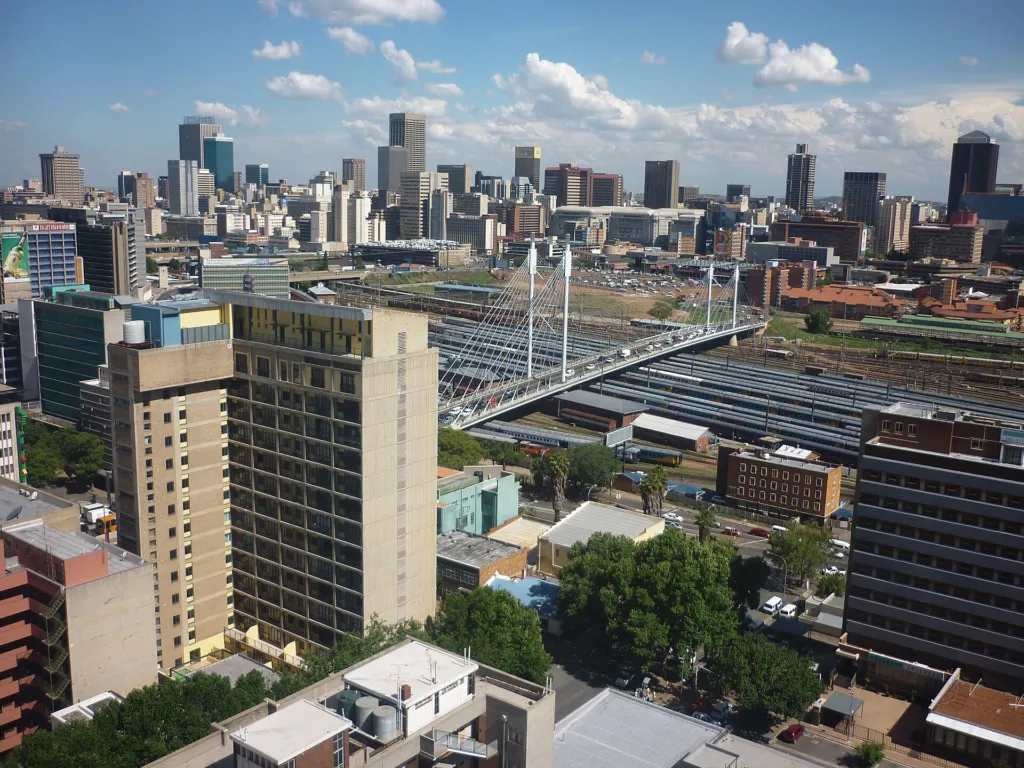
Top photo: Johannesburg’s central business district; no party won a majority on the city council (file photo, 2009). Photo: Evan Bench, Wikimedia Commons, CC BY 2.0
